
Tomme or tome: how do you spell the name of the cheese?
Tomme and tome are both accepted spellings in French when talking about cheese. Tomme, with two “m”s, is more common. For a cheese with a protected designation, use the registered name. Tomme de Savoie PGI takes two “m”s, and Tome des Bauges PDO takes one. Both are mature, uncooked pressed cheeses made with cow’s milk. Tome des Bauges matures for at least five weeks and Tomme de Savoie for at least 30 days. To refer to a volume of a book in French, write un tome. [1] [2] [3]
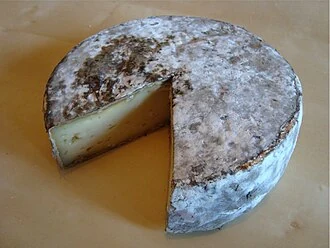
When should you write “tomme” or “tome”?
The Académie française gives tomme as the main entry and accepts tome as a less common variant for cheese. Use une tomme when referring to the cheese in general. When copying a label, writing a restaurant menu or naming a protected cheese, keep the exact name. This is the simplest way to distinguish the products. [1] [2] [3]
| What you mean | Which spelling to use | Example |
|---|---|---|
| A cheese of this type without a specific name | Une tomme. Une tome is also accepted. [1] | A goat’s milk tomme for the cheese board. |
| The cheese from the Bauges massif | Tome des Bauges PDO, with one “m”. [2] | A piece of Tome des Bauges. |
| The cheese with the Savoy PGI | Tomme de Savoie PGI, with two “m”s. [3] | Tomme de Savoie cut to order. |
| The cheese with the Pyrenean PGI | Tomme des Pyrénées PGI, with two “m”s. [4] | Cubes of Tomme des Pyrénées. |
| The Aubrac speciality used in aligot | Tome fraîche de l’Aubrac PGI, with one “m”. [5] | Tome fraîche de l’Aubrac for aligot. |
| A volume of a book | Un tome, with one “m”. [1] | Le deuxième tome d’un livre, the second volume of a book. |
To remember the two Savoy names, think Bauges with one “m” and Savoie with two. In a French sentence, write de la Tome des Bauges and de la Tomme de Savoie. In the plural, des tommes is suitable if you mean several cheeses of this type without specifying their protected names.
Where do the two spellings come from?
The Académie française dictionary links the cheese name to the regional forms toma and tomo, recorded in south-eastern France and used for different cheeses. The Bauges producers link their cheese’s name to toma and the cheesemaking tradition on mountain pastures. These regional uses explain why both spellings exist. Check the product specification for the official form of any protected name. [1] [2] [6]
In the Bauges, families made tome at home for a long time. The PDO producers’ association points to mentions of tomes in price schedules from 1793 and an account of cheesemaking at home in replies to a survey from 1807. The documents distinguish fresh cheeses from dried tomes, among other types. The word therefore referred to several forms of cheese in local usage. [6]
Today’s examples show how the uses overlap. Tome des Bauges is an Alpine cheese aged in a cellar. Tome fraîche de l’Aubrac comes from the Massif Central and is used in cooking, among other things. Tomme des Pyrénées has two “m”s and comes from outside the Alps. When describing a particular cheese, give its region, milk and production method along with its name. [2] [3] [4] [5]
What is the difference between Tome des Bauges and Tomme de Savoie?
Tome des Bauges PDO is tied to the Bauges massif, between Savoie and Haute-Savoie. Tomme de Savoie PGI has a separate designation covering a wider area. Both are uncooked pressed cow’s milk cheeses. Their specifications differ in the milk treatments allowed, the dimensions and the maturation time, among other things. [2] [3]
| Feature | Tome des Bauges PDO | Tomme de Savoie PGI |
|---|---|---|
| Official name | One “m”. | Two “m”s. |
| Area | Designated area in the Bauges massif. | Savoie and Haute-Savoie, plus neighbouring municipalities listed in the specification. |
| Milk | Whole or partly skimmed raw cow’s milk. | Raw or thermised cow’s milk. |
| Paste | Uncooked and pressed, ivory to yellow, slightly firm to supple. | Uncooked and pressed, white to yellow, with a texture that varies from piece to piece. |
| Size | A cylinder 18 to 20 cm across and 3 to 5 cm high, weighing 1.1 to 1.4 kg at the end of maturation. | A cylinder 18 to 21 cm across, weighing 1.2 to 2 kg in the standard size. The small Tomme de Savoie weighs 400 to 900 g. |
| Rind | Grey, thick and uneven, with ridges and possible variation in surface colour. | Grey to whitish grey, smooth to slightly uneven. Surface organisms may develop during maturation. |
| Minimum maturation | Five weeks, or 35 days. | 30 days. |
| Flavour profile | A supple paste that can develop milky, vegetal or lightly toasted notes. | A mild, milky taste in some young pieces, or a stronger flavour after longer maturation. |
Minimum maturation times are production requirements. They do not tell you the age of the piece on sale or rank the cheeses by strength. A long-matured Tomme de Savoie can be stronger than a Tome des Bauges that has only just reached its minimum. To choose by taste, ask how old both pieces are and try them at the cheese counter. [2] [3] [7]
A PDO requires the production stages to take place in the designated area according to the specified methods. A PGI requires a link to the area and at least one stage to take place there. For Tomme de Savoie, the specification places milk production, cheesemaking and maturation within the PGI area. At the cheese counter, the protected name and logo tell these cheeses apart when their rinds look alike. [2] [3] [8]
What do tome fraîche and other tommes refer to?
Tome fraîche de l’Aubrac for aligot
Tome fraîche de l’Aubrac PGI is a speciality made with whole raw cow’s milk. The pressed curd matures briefly and is sold without a rind. It is used to make aligot, where the cheese is heated with mashed potato to give it a stretchy texture. Ask for fresh tome at the counter for this recipe. Mature Tome des Bauges, with its rind, gives a different result. [5]
The term tome fraîche is also used outside this particular designation, including in cheesemaking in Cantal. On a shopping list, write the full name of the product when the recipe depends on it. Here, fraîche helps you identify the ingredient more than the number of “m”s does. [1] [5]
Tomme des Pyrénées and goat’s or ewe’s milk tommes
Tomme des Pyrénées PGI takes two “m”s. It comes in several forms, including black-rind tomme. The specification allows different milks, including ewe’s milk in a blend. At another counter, tomme de chèvre or tomme de brebis tells you the cheese type and milk. Check the label to find where it was made, how the milk was treated and whether it carries a protected designation. [1] [4]
Which should you choose for a cheese board or a recipe?
| If you want… | Which cheese to ask for | How to serve it |
|---|---|---|
| A mild cheese before a meal | A young, supple Tomme de Savoie. | Cut it into cubes and serve with an apple or country bread. |
| A piece with a stronger flavour | Tome des Bauges or a more mature Tomme de Savoie, depending on how it tastes. | Serve in thin slices to compare the aromas without overfilling the board. |
| Two cheeses to compare their regions | Tome des Bauges and Tomme de Savoie, ideally of similar strength. | Serve the pieces side by side, labelled with their name and designation. |
| The cheese for matouille | Tome des Bauges PDO. | Melt it in the oven and serve it over potatoes. [9] |
| A cheese for an open sandwich or roasted figs | Tomme de Savoie PGI. | Cut thin slivers and spread them over the filling or fruit. [9] |
| The cheese for aligot | Tome fraîche de l’Aubrac PGI. | Stir the fresh tome into the mashed potatoes according to the recipe. [5] |
How to compare the two on the same cheese board
Ask for two pieces and let the cheesemonger tell you which is milder. For two people, 50 to 60 g of each cheese gives each person a total tasting portion of about 50 to 60 g. Cut pieces of similar size with some cheese from the centre and some from near the edge. Taste each one on its own, then with plain bread. If one has a particularly strong flavour, serve it last. [7]
For a wider range of textures, see the guide to putting together a Savoy cheese board. Choosing a Savoy cheese explains when to choose a tomme, a cooked pressed cheese or a goat cheese. For a drink to serve alongside, see Savoy cheese and wine pairings.
Can you substitute one for the other in a dish?
For an open sandwich or vegetable gratin, use the cheese you already have. Slice it thinly and taste it before salting the filling. A more mature cheese can give the dish a stronger flavour. To make traditional matouille, get a whole Tome des Bauges and an ovenproof dish close to its diameter. The producers’ recipe melts the tome in the oven with garlic and Savoy white wine. [7] [9]
How to recognise them when buying
- Read the full name. Look for “Tome des Bauges PDO” or “Tomme de Savoie PGI”. Check the name and mark on the packaging or the counter label.
- Look at the rind and cut surface. A very uneven rind points to Tome des Bauges. Confirm by checking the exact name, especially if the cheese is sold in portions.
- Ask how old it is and what milk was used. Tome des Bauges is made from raw milk. Tomme de Savoie can be made from raw or thermised milk. For a mild cheese, taste a young piece before asking for a more mature one.
- Buy the amount you plan to use. A small piece of each is enough for a comparison. For matouille, check that the whole wheel fits your baking dish. [2] [3] [7] [9]
At home, refrigerate both pieces as directed by the seller or the packaging. Wrap them separately to preserve their flavours and take out only what you plan to serve. How to store cheese in the refrigerator gives advice by type of cheese. To buy cheese in the valleys and visit cellars, see the Savoy Cheese Route and the Savoy cheeses guide. [7]
Frequently asked questions about “tomme” and “tome”
Is “tome” a misspelling when it refers to cheese?
No. The Académie française accepts “tome” as a variant of “tomme”. When naming a PDO or PGI cheese, use the spelling of the registered name.
Should you write “Tomme de Savoie” or “Tome de Savoie”?
The official PGI name is “Tomme de Savoie”, with two “m”s. For the Bauges PDO, write “Tome des Bauges”, with one “m”.
Why does “Tome des Bauges” have only one “m”?
That is how the registered name is spelled. The producers link the name to the regional form “toma”, associated with the local cheesemaking tradition.
Are Tome des Bauges and Tomme de Savoie the same cheese?
They are two separate designations. Tome des Bauges is a PDO from the Bauges massif. Tomme de Savoie is a PGI with a wider production area and a specification that allows raw or thermised milk.
How long are the two cheeses matured?
Tome des Bauges PDO is matured for at least five weeks. Tomme de Savoie PGI is matured for at least 30 days. Ask the seller for the actual age of the piece.
Is fresh tome the same as mature tomme?
Tome fraîche de l’Aubrac is a pressed curd that matures briefly. It is used for dishes such as aligot. Tome des Bauges and Tomme de Savoie are matured in cellars and sold with a rind.
Which cheese should you buy for matouille?
Choose Tome des Bauges PDO. In the Bauges recipe, the cheese is melted in the oven and served over potatoes.
Should you write “une tome” or “un tome”?
For cheese, the French noun is feminine. Write “une tomme” or “une tome”. For a book volume, the French word is masculine. Write “un tome”.
Is tomme always made with cow’s milk?
No. The word can refer to cheese made from cow’s, goat’s or ewe’s milk. Tome des Bauges PDO and Tomme de Savoie PGI are both cow’s milk cheeses.
Sources
- Académie française dictionary, “tomme” for cheese and “tome” for a book volume.
- INAO, Tome des Bauges PDO and Official Journal of the European Union, single document and characteristics.
- Official Journal of the European Union, Tomme de Savoie PGI single document and INAO, the two sizes of Tomme de Savoie.
- INAO, Tomme des Pyrénées PGI, permitted milks and coatings.
- Ministry of Agriculture, Tome fraîche de l’Aubrac PGI specification and Jeune Montagne cooperative, Tome fraîche de l’Aubrac and its uses.
- Tome des Bauges producers’ association, history.
- AFTAlp, cutting, storing and tasting order and Tome des Bauges profile.
- INAO, guide to designations of origin and geographical indications.
- AFTAlp, matouille with Tome des Bauges and roasted figs with Tomme de Savoie.