
What is Tomme de Savoie PGI?
Tomme de Savoie PGI is an uncooked pressed cheese made from raw or thermised cow’s milk. Its sometimes mottled grey rind covers a semi-firm white to yellow paste. A standard wheel weighs 1.2 to 2 kg and is matured for at least 30 days. The cheese comes in several fat levels, a legacy of the days when cream was first skimmed off to make butter. Look for the name “Tomme de Savoie” and the PGI logo on the label. [1] [2] [3]
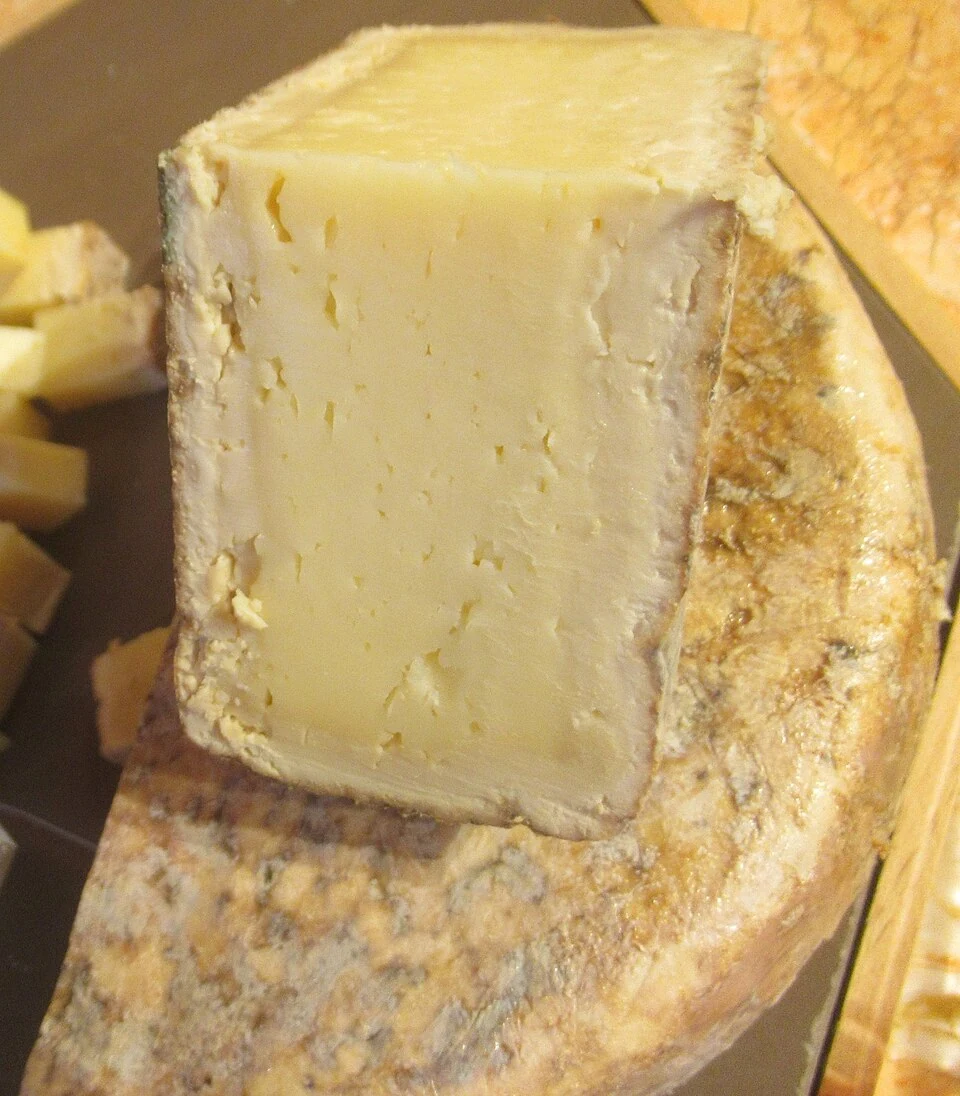
Tomme de Savoie PGI at a glance
| Feature | Characteristics |
|---|---|
| Milk | Raw or thermised cow’s milk. The label tells you how the milk was treated. [1] [2] |
| Paste | Uncooked and pressed, semi-firm, white to yellow and dotted with small openings. [1] [2] |
| Rind | Grey to whitish grey, sometimes uneven or mottled by organisms that develop during maturation. [1] [2] |
| Standard size | A flat cylinder 18 to 21 cm across and 5 to 8 cm high, weighing 1.2 to 2 kg. [1] |
| Small size | 400 to 900 g, no more than 8 cm high. This size is held to the same PGI flavour characteristics. [1] |
| Maturation | At least 30 days from the addition of rennet until the cheese leaves the cellar. [1] |
| Fat content | Several levels depending on how much the milk is skimmed. The specification requires at least 9% fat by total weight. [1] |
The history of Tomme de Savoie, from butter making to the PGI
The name comes from toma, a Savoyard word associated with cheeses made on farms and Alpine pastures. The producers trace the first records of Tomme de Savoie to the 16th century. On the farm, cream was skimmed off to make butter. Families used the remaining milk to make a small wheel for everyday meals. This explains why lower-fat tommes have a long history. The Lake Annecy tourist office recalls that tomme was also served with coffee during the mérande, a Savoyard afternoon snack. [2] [3] [4]
In the 19th century, village dairies pooled milk from several farms. They could make large wheels of cheese, particularly Emmental. Farms and some dairies continued to make smaller tommes according to how much milk was available. The producers introduced a regional label in 1978. The European Union registered “Tomme de Savoie” as a PGI in 1996. [3] [5]
Tomme de Savoie is now made both on farms and in dairies. The INAO and CNAOL survey records 5,987 tonnes sold in 2024, of which 445 tonnes were farmhouse Tomme de Savoie. [6]
Where is Tomme de Savoie made, and what does the PGI guarantee?
The PGI area covers all of Savoie and Haute-Savoie and certain municipalities in Ain and Isère. Farmers produce the milk there, cheesemakers make the wheels there and affineurs mature them there. The Savoy Cheese Route lists farms, village dairies and places to buy cheese in the region. [1] [2]
- The herds. For farmhouse production, at least 75% of the dairy cows in the herd are Abondance, Montbéliarde or Tarentaise, also known as Tarine. In dairies, this threshold is assessed across all herds supplying milk for the PGI. [1]
- Feeding. The specification regulates forage and its origin. It also defines how grass and other green forage can be used, whether grazed or fed fresh. [1]
- Traceability. Producers track batches of milk and cheese. An identification mark allows them to trace a wheel to its workshop. Checks include the conditions in which the milk was produced, maturation and the characteristics of the finished cheese. [1]
The Savoy cheeses guide places Tomme de Savoie alongside the other protected cheeses and local specialities.
How is Tomme de Savoie made and matured?
- Prepare the milk. The cheesemaker uses raw or thermised milk. Thermisation is a heat treatment. Skimming, when used, adjusts the fat content before cheesemaking begins. [1] [7]
- Set the milk. Rennet turns the liquid milk into curd. The cheesemaker cuts and stirs the grains to help the whey drain. If heat is applied during stirring, the temperature is limited to 40°C. [1] [7]
- Mould, press and salt. The curd is divided among moulds or draining baskets and pressed. The identification mark is applied during this stage. The cheese is either dry salted or brined. [1] [7]
- Mature. The tommes are turned regularly in the cellar. The minimum is 30 days from the addition of rennet. Rind care and the development of surface organisms give the cheese its grey, bloomy appearance. [1] [7]
Tomme de Savoie and Raclette de Savoie PGI are both uncooked pressed cheeses. Washing the curd grains to reduce their lactose is part of the Raclette de Savoie method. The Tomme de Savoie specification forbids this step. [1] [8]
What is the difference between Tomme de Savoie PGI and Tome des Bauges PDO?
Tomme de Savoie is spelled with two “m”s. Tome des Bauges PDO is spelled with one and carries a designation specific to the Bauges massif. The label, the milk and the minimum maturation time help distinguish them. [1] [9] [10]
| Feature | Tomme de Savoie PGI | Tome des Bauges PDO |
|---|---|---|
| Area | Savoie, Haute-Savoie and designated municipalities in Ain and Isère. | Designated area in the Bauges massif. |
| Milk | Raw or thermised cow’s milk. | Whole or lightly skimmed raw cow’s milk. |
| Wheel | 1.2 to 2 kg for a standard wheel. | 1.1 to 1.4 kg. |
| Rind | Grey to whitish grey, smooth to slightly uneven. | Grey and more irregular, with a bloom that varies in colour. |
| Minimum maturation | 30 days. | Five weeks. |
How to choose, serve and store Tomme de Savoie
Recognising the PGI and reading the fat content
On the packaging, check the full name “Tomme de Savoie” and the PGI logo. The word “Savoie” can appear on the side or a face of a whole wheel. The specification exempts cheese sold directly to consumers by the farmhouse producer or cheesemaker. At the cheese counter, ask for the exact name if the piece no longer has a visible mark. [1] [10]
To compare the fat content of two tommes, look at the grams of fat per 100 g of cheese. Fat “in dry matter” is calculated after excluding the water. The legal minimum of 9% by total weight is 9 g per 100 g of cheese. When choosing for flavour, ask how long the cheese matured and taste a piece if possible. [1] [2]
Serving tomme
- On a cheese board. Choose a young tomme for a milky taste or ask for a more mature cheese for a stronger flavour. Serve a cut that runs from the paste to the rind, with country bread. [2] [10]
- As an appetiser or on a picnic. Dice the cheese and serve it with apple or walnuts. Keep the cheese cool while travelling. [11]
- In the kitchen. Add thin slices to a savoury tart or grate the tomme over vegetables. The producers suggest a cherry tomato tart and a savoury crumble. [12]
- After buying. Refrigerate the cheese in its packaging and follow the temperature and date on the label. For a portion cut to order, follow the cheesemonger’s instructions. [11]
Frequently asked questions about Tomme de Savoie PGI
How can you recognise Tomme de Savoie PGI?
The full name “Tomme de Savoie” and the PGI logo appear on the packaging. The wheel has a grey rind that may be mottled. “Savoie” may be marked on the side or a face, with an exception for some direct sales.
Is Tomme de Savoie PGI always made with raw milk?
Tomme de Savoie PGI can be made with raw or thermised cow’s milk. Thermisation is a heat treatment. Check the label or ask the cheesemonger to find out which version you are buying.
How long is Tomme de Savoie matured?
The specification requires at least 30 days between adding the rennet and the cheese leaving the cellar. It can mature for longer to achieve a particular taste or texture.
Where is Tomme de Savoie PGI made?
The production area covers Savoie and Haute-Savoie together with certain municipalities in Ain and Isère. The milk is produced and the cheese is made and matured in this area.
Why do some Tommes de Savoie contain more fat than others?
Traditionally, families used the cream to make butter, then made tomme from the remaining milk. Today, the degree of skimming varies. To compare two cheeses, check the grams of fat per 100 g.
What is the difference between Tomme de Savoie and Tome des Bauges?
Tomme de Savoie PGI, with two “m”s, can be made with raw or thermised milk and matures for at least 30 days. Tome des Bauges PDO, with one “m”, is made with raw milk in the Bauges area and matures for at least five weeks.
Sources
- Ministry of Agriculture, Tomme de Savoie PGI specification approved in 2020
- INAO, Tomme de Savoie PGI product profile
- Savoicime, history and origins of Tomme de Savoie
- Lake Annecy Tourism Office, Savoy cooking and the mérande tradition
- EUR-Lex, 1996 regulation registering Tomme de Savoie as a PGI
- INAO and CNAOL, sales volumes of dairy products with quality designations in 2024
- Savoicime, making and maturing Tomme de Savoie
- Ministry of Agriculture, 2026 Raclette de Savoie PGI specification
- AFTAlp, Tome des Bauges PDO profile and specification
- Savoicime, recognising and choosing Tomme de Savoie PGI
- Ministry of Agriculture, the cold chain and storing fresh food
- Savoicime, recipes with Tomme de Savoie