
What is Tome des Bauges PDO?
Tome des Bauges PDO is an uncooked, pressed cheese made from raw cow’s milk. It is produced in the Bauges massif, between Savoie and Haute-Savoie, and matured for at least five weeks. To recognise it, look for the name spelled with a single “m”, the uneven grey rind and the PDO logo. A green identification plate marks farmhouse production and a red one marks dairy production. [1] [2]
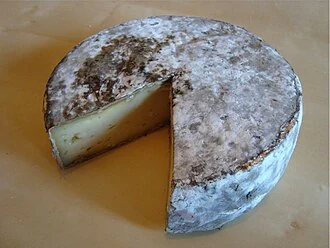
Tome des Bauges at a glance
At the cheese counter, the rind and cut surface offer the first clues. Check the full name and the European logo on the label to confirm the designation. [1] [2]
| Feature | How to recognise it |
|---|---|
| Milk and cheese type | Whole or partly skimmed raw cow’s milk. An uncooked, pressed cheese. |
| Shape | A small cylindrical wheel 18 to 20 cm across and 3 to 5 cm high. |
| Weight | 1.1 to 1.4 kg at the end of maturation. |
| Rind | Grey, with a natural bloom and an uneven surface of ridges and hollows. The specification describes it as tourmentée, meaning irregular in relief. |
| Paste | Ivory to yellow, supple to slightly firm. Small openings may be visible when cut. |
| Flavour | The aromas vary from wheel to wheel and with maturation. The producers describe lactic to lightly woody notes. |
| Maturation | At least five weeks within the PDO area. |
These characteristics are described by INAO, the product specification and the producers’ association. [1] [2] [3]
History of Tome des Bauges
Tome comes from a household economy in which the same milk served several purposes. Families in the massif skimmed off some of the cream to make butter. They turned the remaining milk into cheese for everyday meals. [2] [3]
Local sales predated the sector’s development in the 20th century. The producers’ association points to mentions of fresh and dried tome in the Maximum price schedules of 1793. In 1807, a reply to Prefect Barante’s questionnaire describes a cheese made in rural households and eaten regularly. These two records show its place in family meals and at market stalls. [3]
The official name is spelled Tome des Bauges. According to INAO, tome may come from the Savoyard word toma, associated with cheese made on Alpine pastures. The name received French AOC recognition in 2002 and entered the European PDO register in 2007. The history of Savoy cheeses puts that recognition in the context of the region’s other cheeses. [1] [4]
What the Tome des Bauges PDO guarantees
Milk production, cheesemaking and maturation in the same area
The specification identifies the municipalities or parts of municipalities included in the Bauges massif. All three stages, from producing the milk to maturing the cheese, take place within this area. The rules also cover milk collection journeys. A farm supplying a cheesemaking workshop must have its headquarters no more than 15 km away by road. [1] [2]
The massif’s meadows are used for grazing and haymaking. The return to pasture in the warmer months and the need to stock hay for winter explain why the specification sets different rules for each season. [2]
Dairy breeds and feeding rules
The PDO allows Abondance, Tarentaise (also known as Tarine) and Montbéliarde cattle. Abondance and Tarentaise cows must together make up at least 55% of the dairy herd. Average production is capped at 6,000 kg of milk per lactating cow per year. [2]
| Rule | What it means on the farm |
|---|---|
| Grazing | At least 120 days with grazed grass as the main ration. During that period, supplementary hay is limited to 3 kg a day per dairy cow. |
| Hay in winter | Hay is the main ration. As a general rule, hay from outside the area can cover no more than 20% of the entire herd’s annual requirements, calculated on an as-fed basis. |
| Supplementary feed | Concentrates and dried alfalfa are together limited to 1,800 kg per year for a lactating cow present all year. Separate limits apply to concentrates and alfalfa. |
| Fermented forage and GMOs | The specification rules out silage and wrapped or fermented forage. It also forbids feed made from genetically modified crops. |
The table sets out the general rules in the product specification. [2]
Drought derogation. The order of 2 October 2026 temporarily allows up to 50% of hay to come from outside the area and raises the combined feed supplement limit to 2,000 kg for a lactating cow present all year. It also raises the separate limits for concentrates, dried alfalfa and supplements for heifers. The order applies from 1 August 2026 until each farm returns its herd to pasture, and no later than 31 May 2027. [5]
From raw milk to the cellar
- In the vat, the raw milk may be partly skimmed. The specification calls for a copper vat and sets out how the milk may be ripened.
- At moulding, the curd is distributed by hand or by gravity. The wheels are pressed by stacking them in their moulds and turning them several times.
- In the cellar, the wheels rest for at least five weeks on spruce boards from the area. Regular turning helps the cheese mature and the rind develop.
The specification also sets the cheesemaking parameters and the conditions for salting. [2]
How compliance is checked
An identification plate stays with the wheel. Farmers and cheesemakers keep records of their herds, feed and batches. After the minimum maturation period, wheels are sampled for laboratory and sensory tests. These check, among other things, the characteristics of the cheese and whether it meets the specification. [2]
Operators check their own practices. The Syndicat interprofessionnel de la Tome des Bauges (SITOB) organises internal checks. According to the producers’ association, Certipaq carries out external checks on the association and participating operators. [6]
The sector in numbers
Farmhouse tome is made on the farm. Dairy tome is made in a workshop using collected milk. Both carry the same PDO. At the cheese counter, the colour of the identification plate distinguishes them when it is still visible. [2] [3]
| Year | Total production | Dairy tome | Farmhouse tome |
|---|---|---|---|
| 2021 | 970 t | 838 t | 132 t |
| 2022 | 983 t | 861 t | 122 t |
On 31 December 2022, the association recorded 50 milk producers, 10 farmhouse producers and 5 dairy workshops. The table and these counts describe the years shown. [3]
Choosing and serving Tome des Bauges
- To recognise the PDO, check the full name on the label. A green plate identifies farmhouse production and a red plate identifies dairy production. If the wheel has been cut and the plate removed, ask the seller. [2]
- To taste both styles, pick pieces with a similar maturation period. The paste and flavour change in the cellar. Ask how long each cheese has matured before comparing.
- For a cheese board, cut portions that show both the rind and the paste. Serve them with country bread and put the walnuts on the side so guests can taste the cheese on its own first.
The Savoy Cheese Route points to a village dairy at Aillon-le-Jeune in the massif. To compare the two protected names when shopping, see Tomme de Savoie PGI and the guide Tomme or Tome. The Tomme de Savoie PGI area covers both Savoy departments and certain municipalities in Ain and Isère. The Savoy cheeses page brings together the area’s other PDO and PGI cheeses. [8]
Frequently asked questions about Tome des Bauges PDO
Why is Tome des Bauges spelled with one “m”?
“Tome des Bauges” is the spelling of the protected name. According to INAO, the word may come from “toma”, a Savoyard term associated with cheese made on Alpine pastures.
Where is Tome des Bauges PDO made?
The milk is produced and turned into cheese, and the cheese is matured, within the designated PDO area in the Bauges massif in Savoie and Haute-Savoie.
Is Tome des Bauges always made with raw milk?
Yes. Tome des Bauges PDO is made with whole or partly skimmed raw cow’s milk. The cheese is pressed and uncooked.
How do you tell farmhouse Tome des Bauges from dairy Tome des Bauges?
The green plate identifies farmhouse production and the red plate identifies dairy production. If you buy a cut piece without the plate, ask the seller how it was made.
How long is Tome des Bauges matured?
The specification sets a minimum of five weeks. The cheese matures within the PDO area on spruce boards from that area.
What is the difference between Tome des Bauges PDO and Tomme de Savoie PGI?
Tome des Bauges PDO is tied to the Bauges massif and has its own specification. Tomme de Savoie PGI has a wider production area and different rules. The full name and logo on the label tell you which one it is.
Sources
- INAO, Tome des Bauges profile
- Ministry of Agriculture, Tome des Bauges product specification approved by the European Commission
- SITOB, cheese profile, history and sector figures for 2021–2022
- European Union, regulation registering Tome des Bauges as a PDO, 2007
- Official Journal of 8 October 2026, order of 2 October on the temporary derogation, full text of the order
- SITOB, the designation and how compliance is checked
- Tome des Bauges photograph by Mit-Mit, Wikimedia Commons, WTFPL licence, converted to WebP.
- INAO, Tomme de Savoie PGI product specification