
What is Raclette de Savoie PGI?
Raclette de Savoie PGI is an uncooked pressed cheese made from raw or thermised cow’s milk. The milk comes from a designated area covering Savoie, Haute-Savoie and certain municipalities in Ain and Isère. Cheesemakers make and mature the cheese there for at least eight weeks on wooden boards. Firm and supple when cut, the paste turns soft and stretchy when heated. Look for the name “Raclette de Savoie” and the European PGI logo on the packaging. [1] [2] [3]
Raclette de Savoie PGI at a glance
| Feature | Characteristics |
|---|---|
| Milk | Raw or thermised cow’s milk. Thermisation heats milk less intensely than pasteurisation, which the specification rules out. [1] [2] [3] |
| Paste | Uncooked and pressed, white to straw yellow, sometimes with a few small openings. It turns soft and stretchy when heated. [1] [2] |
| Rind | Yellow to brown, rubbed during maturation. The product specification describes it as a smear rind. [1] [2] |
| Round wheel | 28 to 34 cm across and 6 to 7.5 cm high at the heel. The producers’ association gives 6 kg as a typical weight. [1] [2] [4] |
| Maturation | At least eight weeks on wooden boards. [1] [2] |
| How it is sold | As a whole round wheel, a wedge or slices cut to order, or as prepacked slices. The 2026 specification also allows a block format for producing prepacked slices. [1] [2] |
The history of raclette, from roasted cheese to the PGI
The word raclette refers to both the dish and the cheese used to make it. Traditionally, the cut face of a half-wheel is held in front of a heat source, then the melted layer is scraped off. Savoy producers trace an account of roasted cheese in Maurienne to 1477. That date refers to the technique, which predates the protected cheese name by centuries. The Académie française dates the culinary use of the word to the 19th century and links the dish to the Valais. [5] [6]
In Savoie, the railway and the growth of Alpine tourism opened up new markets for local specialities. In the 1960s, village dairies expanded and diversified production. At the table, electric raclette grills with individual pans made it possible to serve slices to each diner. Serving from a half-wheel preserved the traditional scraping method. [3] [5]
On 16 January 2017, the European Commission adopted the regulation registering “Raclette de Savoie” as a Protected Geographical Indication. The name identifies the Savoy cheese made according to its product specification. Raclette du Valais PDO is a separate designation, with its own Swiss production area and rules. [3] [7] [8]
What does the Raclette de Savoie PGI guarantee?
The specification requires milk production, cheesemaking and maturation to take place in the same geographical area. It covers Savoie, Haute-Savoie and neighbouring municipalities in Ain and Isère. The link to the area comes from its forage resources, dairy herds and the methods cheesemakers use to make and mature the cheese. [1] [2]
- The herds. Abondance, Montbéliarde or Tarentaise cows, also known as Tarine, make up at least 75% of the dairy herd for farmhouse production. For a cheesemaker who collects milk, the threshold is assessed across all the supplying herds. [1]
- Feeding. Grass, hay and other roughage make up the basic ration. The specification sets rules for where they come from and for feeding fresh forage. [1] [2]
- Cheesemaking and traceability. An identification mark is applied during moulding. Producers record the origin of the milk and track batches through cheesemaking and maturation. Checks include time spent in the cellar and the characteristics of the cheese. [1]
The Savoy cheeses guide compares Raclette de Savoie PGI with other protected cheeses, including Emmental de Savoie PGI, a cooked pressed cheese. The Savoy Cheese Route lists village dairies and places to buy cheese. [4] [9]
How is Raclette de Savoie made?
From milk to pressed cheese
- Set the milk. The cheesemaker prepares the milk in a vat, adds starter cultures, then adds rennet to form the curd. The producers give a typical figure of about 60 litres of milk for a standard 6 kg wheel. [1] [10]
- Cut the curd. The curd is cut into grains and stirred. The whey gradually separates from the grains. [1] [11]
- Wash the curd. The grains are washed with water to reduce the lactose they retain. This step is compulsory. It helps control how acidic the curd becomes, one of the factors that affects how the cheese melts. [1] [2] [11]
- Mould and press. The cheesemaker places the grains in a mould, applies the identification mark and presses the cheese. The grains knit together as the cheese drains. [1] [11]
From salting to maturation
After pressing, the cheese is brined. In the cellar, the affineur turns and tends the cheeses on their boards. Rind care and time spent maturing help determine the texture. When heated for serving, a slice becomes soft and stretchy and releases little oil. [1] [2] [11]
How to recognise and choose Raclette de Savoie PGI
Look for the full name “Raclette de Savoie” and the PGI logo on the packaging. The terms fromage à raclette and raclette nature describe a type of cheese. At the cheese counter, ask for the name of the wheel, how it was made and whether the milk was heat-treated. [1] [2] [10]
Raclette de Savoie comes in farmhouse and dairy versions. The first is made on the farm and the second at a cheesemaking facility or village dairy. AFTAlp identifies a farmhouse wheel by its green plate and a dairy wheel by its red plate. For prepacked slices, the packaging is the easiest way to tell. [4] [10]
| Use | Best cut | Serving tip |
|---|---|---|
| Grill with individual pans | Even slices the width of the pan. | Lay a slice flat and remove the pan as soon as the cheese melts. |
| Traditional scraping grill | A half-wheel if it fits the cheese holder. | Hold the cut face up to the heat and scrape off thin layers. |
| Cheese board | A wedge to share. | Cut it so each portion gets some paste and rind. |
| Gratin or open sandwich | Thin slices or small slivers cut from a wedge. | Spread the pieces over the vegetables or bread so they melt evenly. |
How to serve, cook with and store Raclette de Savoie
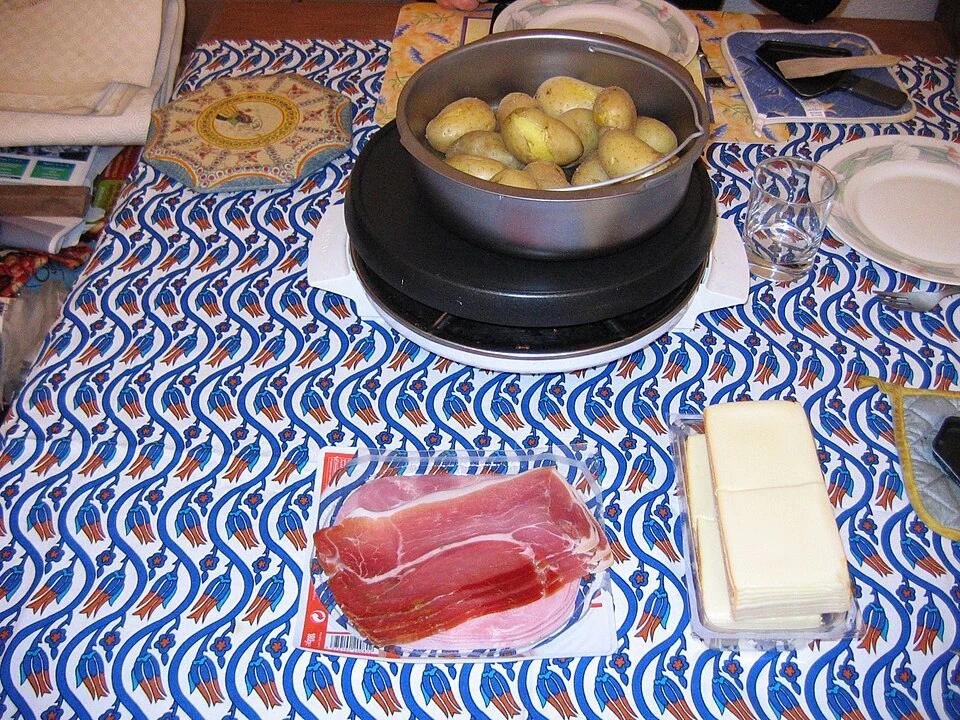
- At the table. Cook firm-fleshed potatoes and add charcuterie, gherkins or roasted vegetables to taste. The acidity of the condiments contrasts with the melted cheese. [3] [6]
- Beyond the raclette pan. Use Raclette de Savoie in a gratin, a toasted sandwich or a vegetable pie. The producers suggest a pie with squash and potatoes. The cheese can also be served cold on a board. [10] [12]
- After the meal. Promptly refrigerate any slices that have not been heated. Store them in their packaging and follow the temperature and date on the label. For a cut portion, follow the cheesemonger’s instructions. [13] [14]
Raclette and tartiflette each have a traditional cheese. Raclette de Savoie PGI is melted in slices or scraped from a half-wheel. Reblochon de Savoie PDO browns in the oven over the potatoes in tartiflette. [3] [15]
Frequently asked questions about Raclette de Savoie PGI
How do you recognise Raclette de Savoie PGI?
Look for the full name “Raclette de Savoie” and the PGI logo on the packaging. If buying a cut portion, ask the cheesemonger for the exact name of the wheel. Prepacked slices can come from a round wheel or from a cheese made in a block for slicing.
Is Raclette de Savoie PGI always made with raw milk?
Raclette de Savoie PGI can be made with raw or thermised milk. Thermisation heats the milk. The specification excludes pasteurisation. Check the label to tell the two versions apart.
Where is Raclette de Savoie PGI made?
Milk production, cheesemaking and maturation take place within the designated area in Savoie, Haute-Savoie and certain neighbouring municipalities in Ain and Isère.
How long is Raclette de Savoie matured?
Raclette de Savoie PGI is matured on wooden boards for at least eight weeks. Cellar care helps it become soft and stretchy when heated.
What is the difference between farmhouse and dairy Raclette de Savoie?
Farmhouse Raclette de Savoie is made on the farm. Dairies and village dairies make the dairy version from collected milk. Both follow the PGI specification.
Which cut should you choose for melting Raclette de Savoie?
For individual pans, choose even slices that fit the pans. For traditional scraping, choose a half-wheel that fits the cheese holder. Heat the cut face and scrape off the melted layer.
Sources
- Ministry of Agriculture, product specification approved in January 2026
- Official Journal of the European Union, amended single document for Raclette de Savoie PGI
- Ministry of Agriculture, Raclette de Savoie PGI profile
- AFTAlp, Raclette de Savoie PGI fact sheet
- Savoicime, the history of Raclette de Savoie
- Académie française, definition and etymology of raclette
- EUR-Lex, 2017 regulation registering Raclette de Savoie as a PGI
- Swiss PDO-PGI Association, Raclette du Valais PDO
- AFTAlp, characteristics of Emmental de Savoie PGI
- Savoicime, recognising Raclette de Savoie and the formats it comes in
- Savoicime, cheesemaking and maturation stages
- Savoicime, Raclette de Savoie, squash and potato pie
- Savoicime, how to store Raclette de Savoie
- Ministry of Agriculture, storage and hygiene for fresh foods
- Reblochon producers’ association, tartiflette recipe