
What is Reblochon de Savoie PDO?
Reblochon de Savoie PDO is an uncooked pressed cheese made from whole raw cow’s milk. It originated around Thônes and the Aravis and is made mainly in Haute-Savoie, as well as in a few municipalities in Savoie. Under its thin yellow-orange rind, the paste is supple and creamy, with a flavour that can recall hazelnuts. A green label identifies farmhouse Reblochon. A red label identifies dairy Reblochon. Both suit a cheese board and tartiflette. [1] [2] [3]
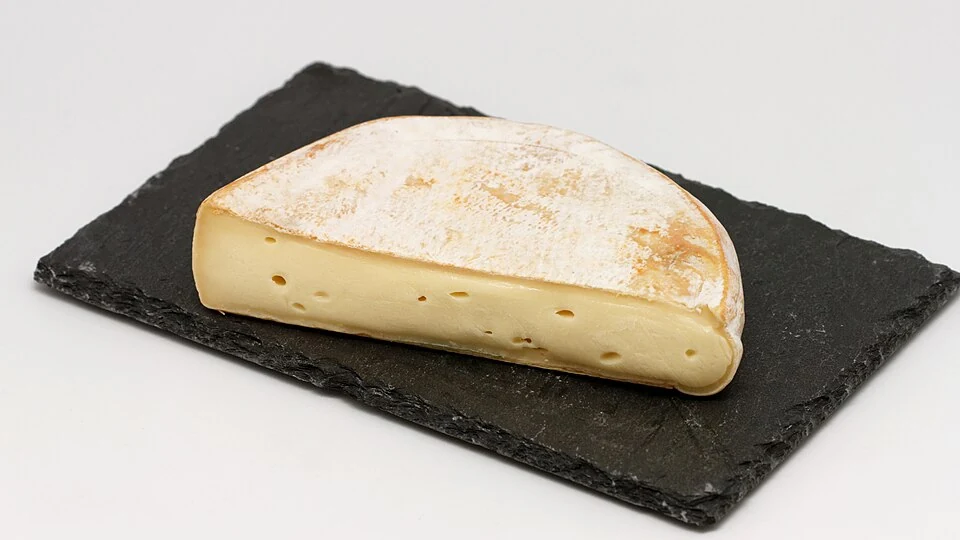
Reblochon de Savoie at a glance
| Feature | Characteristics |
|---|---|
| Milk | Whole raw cow’s milk from herds of Abondance, Montbéliarde or Tarentaise cows. Tarentaise is also known as Tarine. [1] [2] |
| Paste | Uncooked and pressed, supple, cream-coloured to ivory. Small openings may be visible when cut. [1] [2] |
| Rind | Thin and washed, yellow to orange and often covered in a light white bloom. [1] [2] |
| Standard size | About 14 cm across and 3.5 cm high, weighing 450 to 550 g. [1] [2] |
| Petit Reblochon | About 9 cm across and 3 cm high, weighing 230 to 280 g, under the same PDO. [1] [2] |
| Identification | The name “Reblochon” or “Reblochon de Savoie”, the PDO logo and a coloured label on the cheese. A spruce disc accompanies whole cheeses or halves packaged for sale. [1] [2] [3] |
The history of Reblochon and its name
Tradition places the birth of Reblochon in the 13th century on the Alpine pastures around Thônes. The droit d’ociège, a fee for using the pastures, was calculated from the milk the herd gave. According to the story passed down by the producers, some farmers stopped milking before the cows were dry when the milk was checked. They finished once the collector left and used the richer last milk to make a small cheese. The producers’ association links the name to this second milking, called the rebloche. [4]
On 15 February 1699, a deed recorded in the Thônes notarial register lists reblechons among the goods due under a lease. The document reproduced by the Amis du Val de Thônes shows that the name was in use by the end of the 17th century. The deed provides a written date separate from the one in the origin story. [5]
Production stayed modest for a long time. According to the producers’ association, it amounted to no more than 40 tonnes a year at the beginning of the 20th century. The railway and later Alpine tourism opened up more markets. Reblochon received French recognition in 1958 and European registration in 1996. [4] [6] [7]
Where is Reblochon made, and what does the PDO guarantee?
The area covers much of Haute-Savoie, including Thônes, Manigod, La Clusaz and Le Grand-Bornand. It also extends into municipalities or parts of municipalities in Savoie, including Flumet, Crest-Voland and La Giettaz. Farmers produce the milk and cheesemakers make and mature the cheese within this designated area. [1] [2]
The specification covers cattle breeds, feed, cheesemaking methods and conditions in the drying room and cellar. The cows graze in summer and are fed hay in winter. The rules exclude silage and fermented forage. Checks also cover farmhouse methods, identification and maturation time. Compare the region’s protected cheeses in the Savoy cheeses list. The Savoy Cheese Route lists places to visit and buy cheese. [1] [2] [3]
What is the difference between farmhouse and dairy Reblochon?
| What to check | Farmhouse Reblochon | Dairy Reblochon |
|---|---|---|
| Label colour | Green. | Red. |
| Milk source | Milk from the herd on the farm that makes the cheese. | Milk collected from farms in the area and processed at a dairy. |
| Place and schedule | On the farm or at the Alpine pasture where the herd is working, after each of the two milkings. | At a village dairy or other cheesemaking facility. The milk is collected at least once a day. |
| Cheesemaking methods | Cutting the curd, moulding and some of the turns are done by hand. | Working the curd can be mechanised. |
| When choosing | Ask for the farm’s name and how mature the cheese is. | Ask for the workshop’s name and how mature the cheese is. |
The colour tells you how it was made. To judge the character of a piece, the cheesemonger’s guidance on maturity and, if possible, a taste are more helpful. The traceability marking identifies the workshop and batch. [1] [3] [8]
How is Reblochon de Savoie made?
From milk to moulded cheese
- Coagulation. Rennet sets the milk. The product specification gives a setting time of 10 to 20 minutes. The resulting solid mass is called the curd. [1]
- Cutting the curd. The cheesemaker cuts the curd into small grains to let the whey run off. This same liquid can be used to make sérac. [1] [3]
- Moulding. The grains are spread into perforated moulds that give the cheese its flat, round shape. For the standard size of farmhouse Reblochon, a plant-fibre cloth helps with draining. [1]
- Marking. A label made from casein, a milk protein, is applied to the cheese during moulding. Its colour distinguishes the two forms of production. [1] [3]
From pressing to the cellar
- Pressing. A weight placed on each cheese helps drain the whey. The specification requires at least 1 hour and 30 minutes of pressing for dairy Reblochon and 6 hours for farmhouse Reblochon. [1]
- Salting. After draining, the salt can be applied by hand or in a brine bath. [1]
- Early maturation. In the drying room, the cheeses are turned and their surfaces washed. This first stage prepares the rind to develop. [1] [3]
- Maturation. In the cellar, turning and surface care help the cheese develop. The paste softens and the aromas develop. [1] [3]
How long does maturation take?
The specification requires at least 15 days for cheesemaking, early maturation and maturation together. The cheese can leave the workshop no earlier than the 16th day after adding rennet. If wrapped individually from the first cellar stage, it must continue to mature through at least the 18th day. The producers’ association cites maturation periods of up to 35 to 40 days for farmhouse wheels. [1] [3]
How to choose, cook with and store Reblochon
- For a cheese board. Choose a supple paste and a thin rind. Ask for a younger cheese if you want something mild or a more mature piece if the board already has several mild cheeses. [2] [8]
- For tartiflette. Both farmhouse and dairy Reblochon melt well. The standard size suits a family dish. The smaller one lets you adjust the amount for a smaller dish. In the producers’ recipe, some cheese is mixed in with the potatoes and the rest browns on top with the rind left on. [2] [9]
- For a simple meal. Serve Reblochon with country bread, potatoes or a salad. Its melting texture also suits hot open sandwiches and gratins. [9]
- For storage. Keep the cheese refrigerated and follow the temperature and date on the packaging. For a cut portion, follow the cheesemonger’s instructions. [10]
Tartiflette became popular in the 20th century. The producers trace it to péla, a pan-cooked dish of potatoes and Reblochon. The cheese found a familiar place in Alpine resorts while remaining a cheese for the board. [9] [11]
Frequently asked questions about Reblochon de Savoie
Where is Reblochon de Savoie PDO made?
It is made within a defined area covering much of Haute-Savoie and some municipalities or parts of municipalities in Savoie. Thônes, the Aravis and part of the Val d’Arly are in this area.
How did Reblochon get its name?
The producers link its name to the rebloche, the second milking in the traditional story from the pastures above Thônes. A deed in the Thônes notarial register dated 15 February 1699 records the word in the form “reblechons”.
What do the green and red Reblochon labels mean?
Green identifies farmhouse Reblochon, made from the milk of the farm’s own herd. Red identifies dairy Reblochon, made in a workshop from collected milk. Both carry the same PDO.
How long is Reblochon matured?
The specification requires at least 15 days for production, early maturation and maturation together. The cheese can leave the workshop no earlier than the 16th day. If wrapped individually in the first cellar stage, maturation continues through at least the 18th day.
Which Reblochon should you choose for tartiflette?
Either farmhouse or dairy Reblochon can work. For a family dish, the standard size weighs 450 to 550 g. Leave the rind on if you want it to brown along with the paste.
Does Petit Reblochon carry the same PDO?
Yes. It is the smaller format of Reblochon de Savoie PDO. It measures about 9 cm across and weighs between 230 and 280 g.
Sources
- Ministry of Agriculture, approved Reblochon de Savoie specification, especially section 5.6 on production
- Official Journal of the European Union, PDO single document, cheese description and geographical area
- Reblochon producers’ association, production, labels and maturation
- Reblochon producers’ association, origin story and changes in production
- Amis du Val de Thônes, Monique Fillion’s study and reproduction of the 1699 deed
- Légifrance, decree of 2 April 1996 recalling French recognition on 7 August 1958
- EUR-Lex, 1996 regulation registering the European designation
- Reblochon producers’ association, recognising and choosing a Reblochon
- Reblochon producers’ association, tartiflette recipe and other cooking ideas
- Ministry of Agriculture, storage conditions and use-by dates
- Reblochon producers’ association, the history of tartiflette and péla