
What is Beaufort PDO?
Beaufort PDO is a cooked pressed cheese from Savoie, made from whole raw milk from Tarine and Abondance cows. Its large wheel, about 40 kg, is recognisable by its concave heel, the hollow around the edge. The paste is firm when cut, then melts in the mouth. It is matured for at least five months. Two additional terms apply under specific conditions: Beaufort été and Beaufort chalet d’alpage. The first is made from pasture-fed cows’ milk from June to October. The second is made after each milking, in a chalet above 1,500 metres, with milk from a single herd. [1] [2] [3]
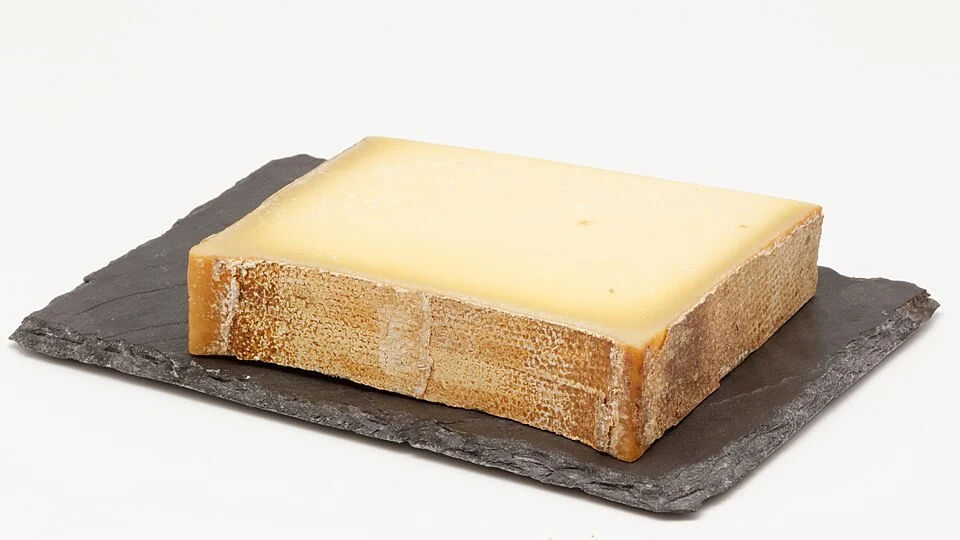
How to recognise Beaufort at the cheese counter
On a cut portion, the heel is the outer edge where the rind is visible. On a piece of Beaufort that still has that edge, it curves inwards. The ivory to pale yellow paste is generally smooth. It can have fine cracks or small openings. When you taste it, the paste gives a little resistance before melting. The aromas vary with the season’s milk and the time in the cellar. [1] [2]
| Feature | What to look for in Beaufort PDO |
|---|---|
| Milk | Whole raw cow’s milk from Tarine (Tarentaise) and Abondance herds. [1] |
| Cheese type | Cooked pressed cheese. The curd is heated during cheesemaking. [1] |
| Size | A wheel weighing 20 to 70 kg, averaging about 40 kg, with a diameter of 35 to 75 cm and a heel 11 to 16 cm high. [1] [3] |
| Rind | Yellow to brown, on a concave heel formed during moulding. [1] |
| Paste | Ivory to pale yellow, firm at first then melting, with few openings. [1] [2] |
| Maturation | At least 5 months from cheesemaking. [1] |
| Traceability | A blue casein plate on the heel. For chalet d’alpage cheese, a square red plate is also applied. [1] |
If the piece has been trimmed and no longer carries the plate, check the name on the counter label or package. Pieces prepacked under the designation must retain some of the rind. To choose by flavour, ask which designation it carries, how old the wheel is and whether you can taste a small piece. [1] [2] [3]
Comparing Beaufort, Beaufort été and Beaufort chalet d’alpage
All three are covered by the same PDO. “Winter Beaufort” is a common way to describe cheese made in the season when the cows eat mostly hay. The label says Beaufort. The two terms laid down in the specification are été and chalet d’alpage. [1] [3]
| Name to look for | When and how is it made? | Tasting profile |
|---|---|---|
| Beaufort | The producers describe it as made from November to May, when the winter diet consists mainly of hay. [3] | Often pale, with milder, milky aromas. [3] |
| Beaufort été | Milk from grazing cows from June to October inclusive. The milk can come from Alpine pastures and be taken to a dairy in the valley. [1] [4] | Often yellower, with fruity or floral notes depending on the wheel and how it has matured. [2] [3] |
| Beaufort chalet d’alpage | Made traditionally in a chalet above 1,500 m from June to October inclusive, after each milking, with milk from a single herd. [1] [4] | Often more pronounced aromas. To compare cheeses from two chalets, ask for cuts of a similar age. [3] |
Beaufort été tells you mainly about the season and the milk from grazing cows. Chalet d’alpage also tells you where and how the cheese is made. Milk from a herd grazing high in the mountains can be collected and made into Beaufort été in the valley. In a mountain chalet, the cheesemaker uses the warm milk on site and repeats the process after the next milking. [1] [4]
Understanding the Beaufort PDO specification
A production area that extends beyond Beaufortain
The PDO area covers municipalities in Alpine Savoie in Beaufortain, Tarentaise, Maurienne and Val d’Arly, as well as two adjoining areas in Haute-Savoie. The milk must be produced in this area, where the cheese is also made and matured. [1] [2]
Grazing, hay and the two breeds
The herds use meadows and Alpine pastures in the warmer months. Hay is the main winter feed. The specification regulates the origin of forage and prohibits silage on the farm. It caps production at 5,000 kg of milk per lactating cow per year, averaged across the herd. The cap applies at farm level. [1]
Tarine, also called Tarentaise, and Abondance are the two breeds that supply the milk. Abondance is also the name of a different cheese with its own product specification. The Abondance PDO profile compares the two. For more on geographical protection, see the guide to Savoy PDO and PGI cheeses. [1] [5]
Following the cheesemaking process from raw milk to cellar
The milk arrives at the dairy and is used whole and raw. The cheesemaker uses a copper vat, starter cultures and rennet to make the curd. “Cooked pressed cheese” describes how the grains of curd are treated after coagulation. [1] [6]
- Coagulating and cutting. Rennet sets the milk. The cheesemaker cuts the curd into small grains to let the whey drain. [1] [6]
- Cooking and stirring. The grains are stirred and heated to between 53 and 56°C in the whey. The cheesemaker judges when to draw off the curd by how well the grains hold together. [1] [6]
- Moulding and pressing. The curd is gathered in a linen cloth and placed in the wooden ring that shapes the concave heel. Turning the wheel during pressing helps it drain. The casein plate applied to the heel identifies the workshop and how the cheese was made. [1] [6]
- Salting and maturation. After brining, the wheels spend at least five months on spruce boards. They are tended and turned in the cellar. The paste and aromas develop over the months. [1] [6]
The whey separated from the curd can also be used on site. At the Bagnaz Alpine pasture, the producers describe using it to make sérac, a fresh cheese. [7]
The history of Beaufort
The Beaufort producers’ association dates the development of large Gruyère-style wheels, called grovire, in Beaufortain to the 17th century. They kept and travelled better than smaller cheeses and allowed producers to make use of the abundant summer milk beyond the grazing season. The specification cites a 1929 agricultural survey in which Beaufort was already sold under a name distinct from Gruyère. [1] [8]
Production declined after the Second World War. A first dairy cooperative, formed in 1961, allowed farmers to pool their milk and take responsibility for cheesemaking, maturation and sales. Beaufort received AOC recognition in 1968 and the name was registered as a European PDO in 1996. The producers’ association, established in 1975, brings together dairy farmers and cheesemakers. [8] [9]
Cooperatives and cheesemaking in mountain chalets still exist side by side. One processes milk from several farms. The other keeps cheesemaking at the place of milking. Both ways of working help explain the history of Savoy cheeses, from Alpine pasture wheels to protected names. [3] [4] [8]
Beaufort production in numbers
For 2025, the producers’ association reports 5,016 tonnes made in 33 workshops. It lists dairy cooperatives, pastoral groups, economic interest groups and individual producers. The number of wheels varies considerably by category. [3]
| Production category | Number of wheels in 2025 |
|---|---|
| Beaufort | 67,679 |
| Beaufort été | 51,045 |
| Beaufort chalet d’alpage | 8,254 |
Of the 126,978 wheels reported across the three categories, chalet d’alpage accounts for about 6.5% by number of wheels. Its share illustrates the difference between summer production and traditional cheesemaking on site from a single herd. [3]
How to choose, serve and cook with Beaufort
On a cheese board
For a mild tasting, choose a wheel with mostly milky notes and ask how old it is. For a fruitier or more floral cheese, try Beaufort été. Chalet d’alpage works well in a tasting alongside a Beaufort été of a similar age. The guide to putting together a Savoy cheese board suggests pairings with softer cheeses or a goat cheese. [2] [3]
- To taste the difference between two wheels, try each piece on its own first. Then add country bread or a few walnuts.
- For a stronger cheese, ask for a longer maturation. INAO puts the typical flavour profile at around 7 to 12 months and describes more powerful aromas after that. [2]
- To compare with Comté, start with pieces of a similar age. Beaufort or Comté explains the differences in origin, maturation and use.
In fondue, gratin or crozets
Beaufort melts when added gradually to fondue. Grating it or cutting it finely helps distribute it evenly. A mild wheel gives a milky base, while an older piece has a stronger effect on the blend. The guide to which cheeses to use for fondue explains how to put the blend together. The guide to which wine to serve with fondue distinguishes the cooking wine from the wine for the table.
For a crozet or potato gratin, stir Beaufort into the dish and grate it on top. Use a leftover piece to add flavour to soup or top a hot slice of toast. For serving it at the table, the Savoy cheese and wine pairings guide helps you choose a wine based on the strength of the cheese. [3]
Storing a cut piece
Return the rest to the refrigerator in its wrapping and follow the storage instructions given at purchase. For cheese cut to order, ask the cheesemonger how soon to eat it. When cooking, cut only the amount you need with a clean knife. The guide to storing cheese in the refrigerator explains where to put it and how to wrap it. [11]
Buying Beaufort and visiting a dairy
Beaufort is sold at cooperatives, producers’ shops, cheesemongers and cheese counters. For a specific request, say which type you want and how you plan to use it. At a cooperative shop, ask whether the wheels come from the workshop on site or another local dairy. [10]
To compare prices, check the price per kilogram for cuts with the same designation and a similar maturation. Consider how much you need as well. A piece sold for cooking may work for fondue. On a cheese board, a cut with the heel shows the cheese’s distinctive shape.
- In Beaufortain, visiting a cooperative shows how milk is collected and cheese is made across the valley.
- In Tarentaise or Maurienne, some sites show workshop cheesemaking, cellar maturation or counter sales.
- At a mountain chalet, ask about access, the season and production hours. Visitors and sales may be welcomed at a different time from milking. [4] [10]
To plan a route, see the Savoy Cheese Route. To place Beaufort among the eight protected names represented by the producers’ association, see the list of Savoy cheeses.
Frequently asked questions about Beaufort PDO
What is Beaufort PDO?
Beaufort PDO is a Savoy cheese made from whole raw cow’s milk. This cooked pressed cheese is matured for at least five months. Its wheel weighs about 40 kg on average and is recognisable by its concave heel.
What is the difference between Beaufort été and Beaufort chalet d’alpage?
Beaufort été is made from the milk of grazing cows from June to October. Chalet d’alpage is made during the same months, on site above 1,500 metres, after each milking and with milk from a single herd.
Is winter Beaufort an official designation?
“Winter Beaufort” commonly describes Beaufort made when the cows eat mainly hay. The label reads Beaufort. The two terms governed by the specification are “été” and “chalet d’alpage”.
Why does Beaufort have a concave heel?
The inward curve comes from the wooden ring used to mould the cheese. It is visible on the edge of a whole wheel or a piece that still has its heel.
How do you identify Beaufort chalet d’alpage?
Look for the words “chalet d’alpage” at the point of sale. On a whole wheel, there is a square red casein plate in addition to the blue traceability plate. The colour of the paste varies from wheel to wheel.
How long must Beaufort be matured?
The specification requires at least five months from cheesemaking. INAO generally places the typical flavour profile between seven and twelve months. Longer maturation often produces stronger aromas.
Which cows give the milk for Beaufort?
The specification allows two breeds: Tarentaise, also called Tarine, and Abondance. The cheese is made with their whole milk, used raw.
Which Beaufort is best for fondue?
A mild Beaufort can be the base of a blend. Beaufort été often adds fruitier notes. Taste the cheese at the counter to choose how strong it should be in relation to the others in the recipe.
How long has Beaufort been protected?
Beaufort received national AOC recognition in 1968. It was registered as a PDO at European level in 1996.
Sources
- Ministry of Agriculture, Beaufort PDO product specification published on 10 April 2025.
- INAO, Beaufort PDO profile, tasting characteristics and reference texts.
- Beaufort producers’ association, characteristics, designations and 2025 production figures. The share of chalet d’alpage is calculated from the three published wheel counts.
- Beaufort producers’ association, from Alpine chalet to cooperative.
- AFTAlp, Abondance PDO profile.
- Beaufort producers’ association, cheesemaking methods.
- Beaufort producers’ association, making sérac at the Bagnaz Alpine pasture.
- Beaufort producers’ association, history of the cheese and cooperatives.
- European Union, 1996 regulation registering Beaufort among other names.
- Beaufort producers’ association, places to buy cheese and see it being made.
- Ministry of Agriculture, food storage and the cold chain.