
What is Abondance PDO?
Abondance PDO is a semi-cooked pressed cheese from Haute-Savoie made with whole raw cow’s milk. A wheel weighs 6 to 12 kg and is recognisable by its concave heel, the hollow running around its edge. After at least 100 days of maturation on spruce boards, its ivory paste remains supple. Its fruity flavour may have hints of hazelnut and a slight bitterness. Serve Abondance on a cheese board. It is also the only cheese in the recipe for Berthoud TSG, a Chablais dish browned under the grill. [1] [2] [3] [4]
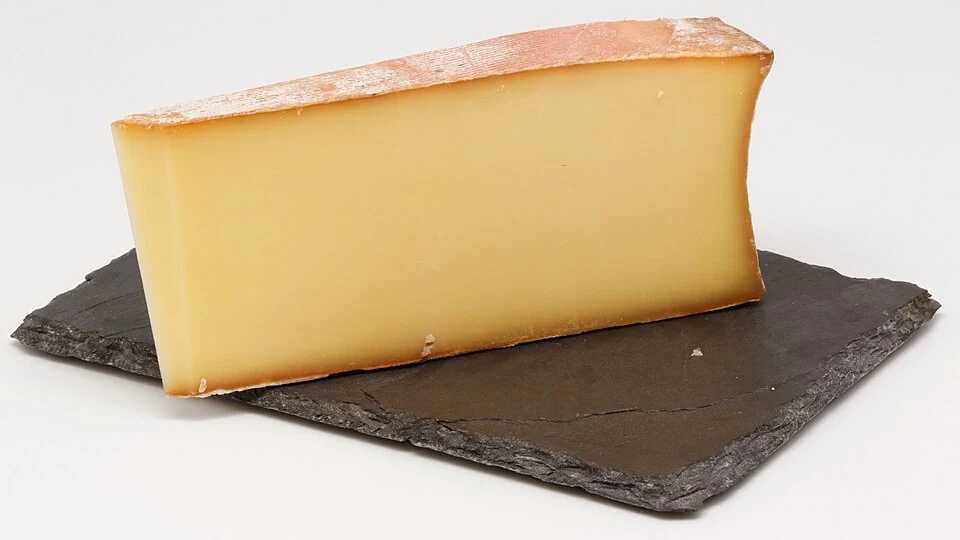
Abondance PDO at a glance
| Feature | Characteristics |
|---|---|
| Origin | The Abondance Valley in Chablais. The PDO covers other mountain areas of Haute-Savoie, including the Aravis and Mont Blanc areas. [1] [2] |
| Milk | Whole raw milk from Abondance, Montbéliarde or Tarentaise cows, also known as Tarine. [1] |
| Wheel | 6 to 12 kg, about 40 cm across and 7 to 8 cm high. The moulding ring gives the heel its concave shape. [1] [3] |
| Rind | Amber to ochre brown, with the imprint of the cloth. The surface is rubbed during maturation. [1] [3] |
| Paste and flavour | A supple, melting paste, ivory to pale yellow and sometimes dotted with small openings. Fruity aromas and hazelnut notes. [1] [2] [3] |
| Maturation | At least 100 days from the addition of rennet, on spruce boards. The cellar is kept between 10 and 13°C. [1] |
The history of Abondance, from mountain pastures to the PDO
Abondance is the name of a valley, a village, a breed of cow and a cheese. The producers’ association links the development of the cheese to the monks of Abondance Abbey and the families who worked the land. In the Middle Ages, clearing the land opened up meadows and grazing for the herds. Some of the milk was turned into cheese that could be stored, traded or used to pay dues. [1] [5]
The producers’ account also places the cheese at tables in Avignon in the late 14th century and at the court of Savoy. Two more recent dates mark the protection of the name. Abondance received French AOC recognition in 1990 and was registered as a European PDO in 1996. [2] [5] [6]
The Ministry of Agriculture reports production of 3,479 tonnes in 2023, including 854 tonnes of farmhouse cheese. Its figures for the same year list 72 farmhouse producers and 17 processing workshops. These figures show the relative scale of the two ways of making the cheese. [2]
Where is Abondance made, and what does the PDO guarantee?
The milk is produced in a defined area of Haute-Savoie, where the cheese is also made and matured. The ministry counts 176 municipalities in the production area. Chablais, home to the Abondance Valley, is its birthplace. Cheesemaking continues in the Aravis and Mont Blanc areas too. See the Savoy Cheese Route for places to buy cheese or visit. [1] [2]
The product specification sets out the following conditions, among others. [1] [7]
- Dairy breeds. The three permitted breeds are Abondance, Montbéliarde and Tarentaise. The minimum of 45% Abondance cows applies across all herds registered under the designation, and also applies to herds that entered the sector after 7 December 2012.
- Grazing and forage. The standard rule requires 150 days of grazing each year. An order issued because of drought reduced the minimum to 120 days for 2026. The specification also sets rules for the origin of forage and prohibits fermented feed in the dairy cows’ ration.
- Traceability. Farmers, cheesemakers and affineurs keep records. A label on the heel identifies how the wheel was made and allows it to be traced to the workshop. Samples are taken to check the cheese’s characteristics.
The Savoy cheeses guide places Abondance among the region’s protected cheeses and local specialities. [3]
How is Abondance made and matured?
- Set the milk. The raw milk is worked in an open copper vat. The cheesemaker adds rennet to form the curd. The ministry gives a typical figure of about 10 litres of milk for 1 kg of cheese. [1] [2]
- Cut and heat the curd. The curd is cut into grains, which are heated to 45 to 50°C to help the whey separate. This treatment of the curd explains why the cheese is described as “semi-cooked”. [1]
- Mould and press. The curd is put in a ring that gives the heel its concave shape. In farmhouse production, the curd is lifted from the vat in a cloth. Pressing takes at least 7 hours. The identification plate is applied during this stage. [1] [3]
- Salt and mature. Salting can begin in brine. In the cellar, the affineur regularly turns and rubs the wheels resting on spruce boards. This helps maintain the morge, the surface flora that contributes to the rind’s appearance. [1]
Emmental de Savoie PGI is a cooked pressed cheese. Abondance’s semi-cooked paste has a different, more supple texture beneath its rubbed rind. [1] [8]
What is the difference between farmhouse and dairy Abondance?
| Feature | Farmhouse Abondance | Dairy Abondance |
|---|---|---|
| Label on the heel | Green and oval. | Red and square. |
| Milk | From the herd on the farm that makes the wheel. | Collected from farms in the PDO area and made into cheese at a workshop. |
| Cheesemaking | On the farm. The cheesemaker lifts the curd out of the vat in a cloth. | At a village dairy, cooperative or another authorised dairy. |
| Maturation | On the farm or in an authorised maturation cellar within the PDO area. | In the dairy’s cellar or at an authorised affineur’s premises within the area. |
Both versions meet the PDO specification. At the cheese counter, the label identifies how the cheese was made. When choosing between two wheels, ask how long they were matured and, if possible, taste a piece of each. [1] [2] [3]
How to choose, cook with and store Abondance
- For a cheese board. Choose a piece that shows both the rind and paste. A supple, fruity Abondance goes well with country bread, walnuts or a pear. Next to Reblochon de Savoie PDO, it offers a firmer cut and a different flavour. [1] [3]
- For Berthoud. The protected recipe uses at least 180 g of rindless Abondance per serving. The cheese melts in an individual dish with garlic, Savoy white wine, Madeira or port, and pepper. Nutmeg is optional. Serve hot once the top has browned and the centre is still melting. [4] [9]
- For an everyday dish. Grate Abondance over potatoes, slice it for a hot open sandwich or add it to a gratin. [3] [10]
- After buying. Keep the cheese refrigerated and follow the date and temperature on the packaging. For a piece cut to order, follow the cheesemonger’s instructions. [11]
The PDO protects the name Abondance for the cheese and links it to its production area. The TSG, or Traditional Speciality Guaranteed, protects the traditional Berthoud recipe, whose main ingredient is Abondance PDO. [1] [4] [9]
Where can you buy Abondance PDO?
In Haute-Savoie, farms and village dairies in the sector sell cut portions. At a cheese counter, look for the name “Abondance” and the PDO logo on the label. If a piece no longer carries the identification plate, ask the seller whether it came from a farmhouse or dairy wheel. [1] [13]
Frequently asked questions about Abondance PDO
How do you recognise Abondance PDO?
A wheel has a concave heel, an amber rind marked by the cloth and a supple, ivory to pale yellow paste. On the packaging, look for the name “Abondance” and the European PDO logo.
Where is Abondance PDO made?
Abondance is made exclusively within the designated area of Haute-Savoie. It originated in the Abondance Valley in Chablais. The area also covers other parts of Haute-Savoie, including the Aravis and Mont Blanc areas.
What is the difference between farmhouse and dairy Abondance?
A green oval plate identifies cheese made on the farm from its own herd’s milk. A red square plate identifies cheese made in a workshop from collected milk. Farmhouse Abondance can be matured in another authorised cellar within the area.
How long is Abondance matured?
Abondance is matured for at least 100 days from the addition of rennet. The wheels rest on spruce boards and the affineur regularly turns and rubs them.
Why is Abondance described as semi-cooked?
The cheesemaker heats the curd grains to between 45 and 50°C before moulding. The cheese is still made from raw milk because this heating applies to the curd after the milk has set.
Which cheese should you use for Berthoud?
Berthoud TSG is made exclusively with Abondance PDO. The recipe calls for at least 180 g of rindless cheese per person, browned in an individual dish with garlic and the wines specified in the recipe.
Sources
- Ministry of Agriculture, Abondance PDO product specification, edition approved in 2019
- Ministry of Agriculture, Abondance PDO and sector figures for 2023
- AFTAlp, Abondance PDO profile and wheel characteristics
- Official Journal of the European Union, Berthoud TSG product specification
- Abondance producers’ association, history of the valley
- EUR-Lex, 1996 regulation registering the European designation
- Légifrance, order of 21 August 2026 on temporary grazing and feeding conditions
- AFTAlp, Emmental de Savoie PGI profile
- EUR-Lex, 2025 regulation approving the amendment to the Berthoud specification
- Abondance producers’ association, recipes and cooking with Abondance
- Ministry of Agriculture, storage conditions for fresh food
- Abondance producers’ association, directory of producers and places to buy the cheese