What goat cheeses come from the Alps?
Alpine goat cheeses include the soft, washed-rind Chevrotin PDO, the farmhouse Persillé des Aravis, which sometimes develops blue veins, and farmhouse specialities such as goat’s milk tomme, fresh goat cheese and goat’s milk sérac. In south-eastern France, Banon PDO, matured under chestnut leaves, and Picodon PDO, a small disc from the Drôme and Ardèche, offer two other ways of working with goat’s milk. [1] [3] [4] [5] [6]
The main goat cheeses of the Alps and neighbouring regions
The table distinguishes Savoyard specialities from cheeses of the Provençal Prealps and the Rhône Valley. Three names are protected by a Protected Designation of Origin. Each has its own production area and rules, from the milk used to the way the cheese is matured. [1] [5] [6] [7] [8]
| Cheese | Region | Status | How to recognise it |
|---|---|---|---|
| Chevrotin | Savoie and Haute-Savoie | PDO | Soft farmhouse disc made from whole raw milk, with a washed rind. [1] [2] |
| Persillé des Aravis | Aravis massif | Farmhouse speciality with neither PDO nor PGI status | A cylinder of raw goat’s milk cheese with a crumbly paste, sometimes marbled with fine blue veins. [3] [7] |
| Goat’s milk tomme | Notably the Bauges massif | A style of cheese, with methods that vary from farm to farm | Its paste and rind change with time in the cellar. [4] |
| Goat’s milk sérac | Notably the Bauges massif | Farmhouse speciality | A fresh cheese made by heating the whey left over from making another cheese. [4] |
| Banon | Haute-Provence and neighbouring municipalities within the PDO area | PDO | A small whole raw milk cheese wrapped in brown chestnut leaves and tied with raffia. [5] |
| Picodon | Drôme, Ardèche and neighbouring municipalities within the PDO area | PDO | A small whole raw milk disc whose paste firms up as it matures. [6] |
In Savoie and Haute-Savoie, Chevrotin and Persillé des Aravis are good starting points for comparing a washed-rind goat cheese with a more crumbly one. The Savoy cheeses guide places these two specialities alongside the area’s other cheeses.
A history of goat farming and farmhouse cheesemaking
In the Bauges massif, families traditionally kept goats alongside cows. They could sell the cow’s milk and use the goat’s milk to feed the household. Cheeses made at home served several purposes. White tomme was eaten young, goat’s milk tomme could mature in the cellar, and the whey was used to make sérac. These practices appear in France’s national inventory of intangible cultural heritage. [4]
Goat farmers in the Bauges still practise inalpage, the seasonal move to high-altitude pastures. The inventory describes farms that keep both goats and cows, as well as producers who sell cheeses on the farm or at markets. [4]
In the Aravis, combining curd from several milkings made it possible to make a cheese with the milk of a small herd. The two traditions produce different results in the cellar. Chevrotin is tended to develop a washed rind and a supple paste. Persillé des Aravis can develop blue veins as it matures. [1] [3] [9]
Chevrotin PDO and Persillé des Aravis, two Savoyard goat cheeses
Chevrotin PDO, the washed-rind goat cheese
Chevrotin PDO is made on the farm from the whole raw milk of a single goat herd. The curd is moulded and pressed. The care given to the rind during cheesemaking and maturation contributes to its pinkish-white appearance. The cheese weighs 250 to 350 g. Cheesemaking, drying and maturation take at least 21 days from the addition of rennet. [1]
Its area includes parts of the Aravis, Chablais, Mont Blanc massif and Bauges. Savoie and Haute-Savoie therefore share this designation, which received AOC recognition in 2002 and PDO status in 2005. The washed rind and pressed paste recall the method used for Reblochon, a cow’s milk cheese from the same region. [1] [2] [3]
Persillé des Aravis, a pale cheese that can develop blue veins
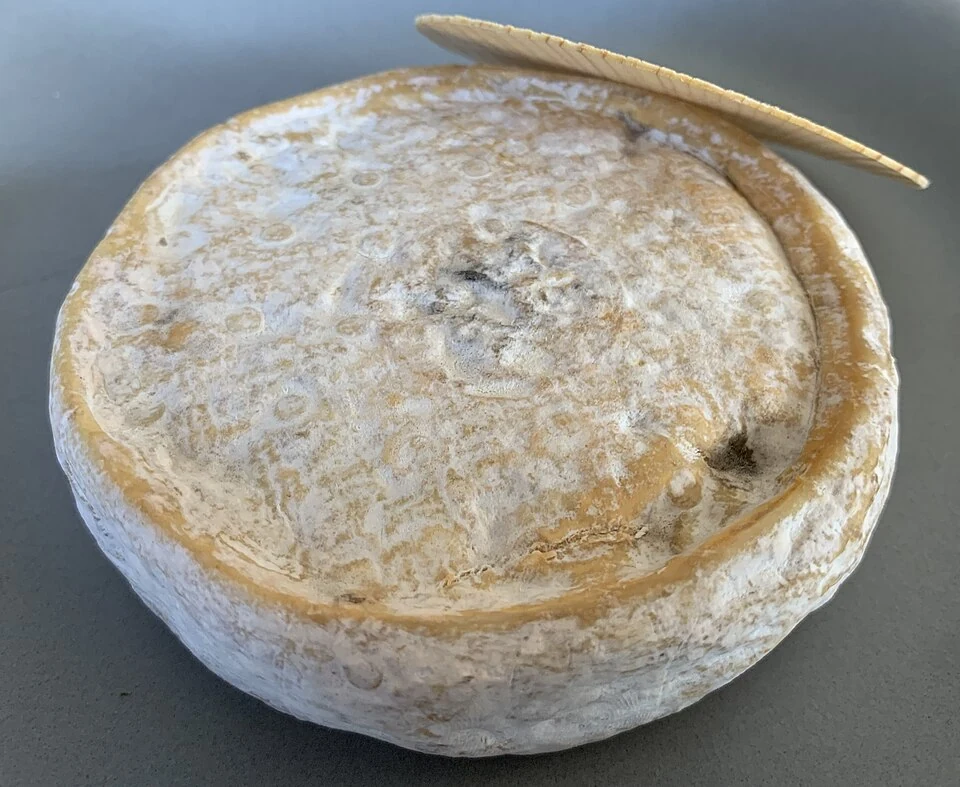
Persillé des Aravis is traditionally a farmhouse cheese. The raw goat’s milk cheeses described around Thônes are white to beige and crumble when cut. The rind thickens and darkens as the cheese matures. Fine blue marbling can develop naturally in the cellar. It varies from cheese to cheese, and some pieces stay pale. [3] [9]
At the cheese counter, choose Chevrotin for a softer paste. Choose Persillé des Aravis for a more crumbly texture and, when it has matured for longer, an often stronger flavour. [1] [3]
Banon and Picodon, two ways of ageing goat cheese in south-eastern France
Banon PDO, the goat cheese wrapped in chestnut leaves
Banon comes from Haute-Provence. It first matures unwrapped. The cheesemaker then wraps each piece in brown chestnut leaves and ties the parcel with raffia. The cheese spends at least 10 days in the leaves, out of at least 15 days of maturation after the rennet is added. Contact with the leaves contributes to its aromas. [5]
Picodon PDO, the small disc from the Drôme and Ardèche
The Picodon area centres on the Drôme and Ardèche, with extensions into the Gard and Vaucluse. A standard cheese measures 5 to 7 cm across at the end of maturation. Its small size makes it easy to serve whole or cut into wedges. Depending on its age, the goat’s milk flavour may be accompanied by hazelnut notes or a little sharpness. [6]
Does “Chèvre des Alpes” have PGI status?
The European eAmbrosia register lists no PDO or PGI under the name “Chèvre des Alpes”. The appointment of a committee to examine a possible application could not be confirmed in INAO publications. If a cheese is sold under a general name that refers to the Alps, check the producer, where it was made, how the milk was treated and, where applicable, the exact protected name on the label. [7] [8]
How to choose and serve Alpine goat cheeses
| What you want | Which cheese to choose | Serving idea |
|---|---|---|
| A fresh, spreadable texture | Fresh farmhouse goat cheese | Toast, chives and pepper. |
| A soft goat cheese for a cheese board | Chevrotin PDO | Country bread and a few slices of pear. |
| A crumbly texture and a stronger flavour | Well-matured Persillé des Aravis | Small servings with walnut bread. |
| A creamy goat cheese to share | Banon PDO | Unwrap it at the table and serve with bread. |
| A small cheese for a warm starter | Picodon PDO | Place on a slice of bread and grill briefly. |
- At the farm or market, ask how long the cheese has matured. Two pieces from the same maker can have different textures.
- At the cheese counter, explain what you want to use it for. Choose a younger cheese to spread on bread and a firmer one if you want to shave it.
- When tasting several cheeses, start with a fresh goat cheese, follow with Chevrotin and finish with the most mature Persillé.
- When planning a visit, consult the Savoy Cheese Route and check which days the farm is open.
Frequently asked questions about Alpine goat cheeses
Which goat cheeses are found in the French Alps?
The Savoy Alps have Chevrotin PDO, Persillé des Aravis and farmhouse cheeses such as fresh goat cheese, goat’s milk tomme and goat’s milk sérac. Further south, Banon is a speciality of Haute-Provence. Picodon comes mainly from the Drôme and Ardèche.
Which Savoyard goat cheese has PDO status?
Chevrotin is a farmhouse cheese made from whole raw goat’s milk, with an uncooked pressed paste and a washed rind. Its area covers parts of Savoie and Haute-Savoie. It has held European PDO status since 2005.
Does “Chèvre des Alpes” have PGI status?
No PDO or PGI is recorded under the name “Chèvre des Alpes” in the European eAmbrosia register. To check a designation, search for the exact name on the cheese label.
What is the difference between Chevrotin and Persillé des Aravis?
Chevrotin is a soft washed-rind cheese protected by a PDO. Persillé des Aravis is more crumbly and can develop blue veins as it ages. Both are made with raw goat’s milk in Savoie and Haute-Savoie.
Are all Alpine goat cheeses made from raw milk?
Whole raw milk is required for Chevrotin PDO, Banon PDO and Picodon PDO. For another farmhouse cheese, read the label or ask the maker how the milk was treated.
Which goat cheeses work on a Savoy cheese board?
A fresh goat cheese, Chevrotin and Persillé des Aravis offer three textures. Serve the fresh cheese first and the most mature Persillé last so the strongest flavours come at the end.
Sources
- Ministry of Agriculture, Chevrotin PDO specification.
- Ministry of Agriculture, Chevrotin and the Savoy pastures.
- Thônes Cœur des Vallées Tourism Office, cheeses of the Aravis.
- Ministry of Culture, inventory of goat farming and cheesemaking knowledge in the Bauges.
- INAO, Banon PDO profile and references to the product specification.
- European Union, Picodon PDO single document and INAO, Picodon profile.
- European Commission, eAmbrosia register of geographical indications.
- INAO, product specifications and recognition of a PDO or PGI.
- Slow Food Foundation for Biodiversity, Persillé des Aravis profile.