What is Bleu de Termignon?
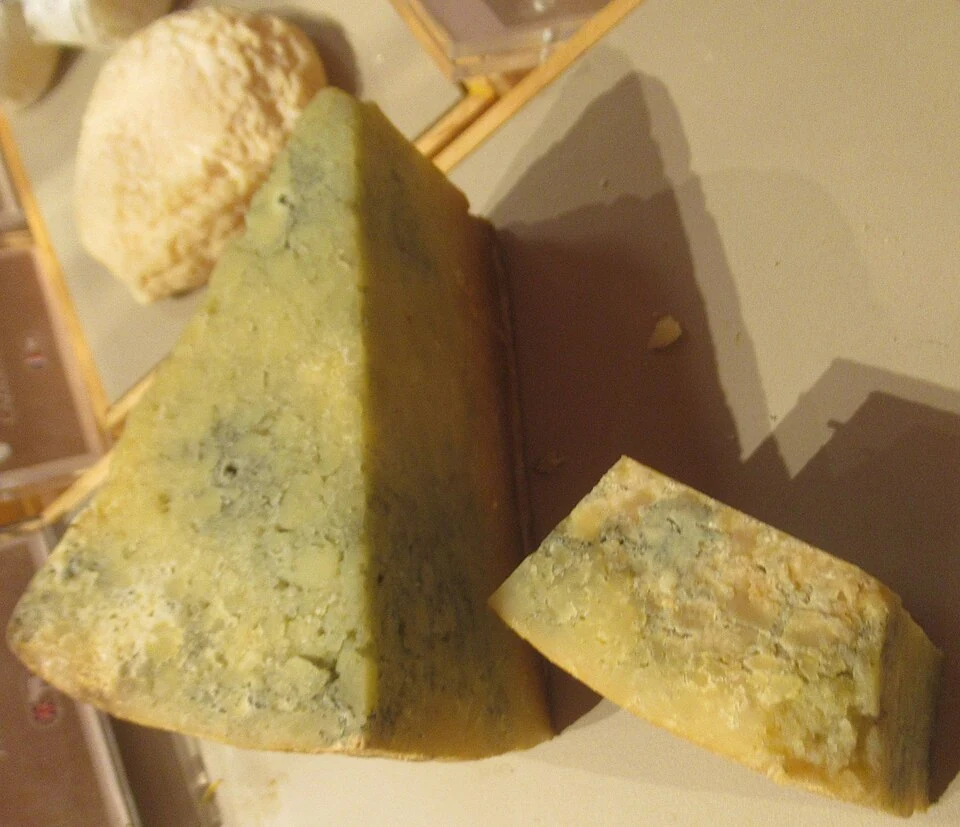
Bleu de Termignon is a farmhouse cheese made from raw cow’s milk during the summer grazing season on the Alpine pastures of Termignon, in Val-Cenis, Haute-Maurienne. Under its thick rind, the pale paste crumbles easily at the centre and may be softer near the edge. The blue veins develop without any added culture intended to produce blue veining. Depending on the wheel and its age, they can be faint, pronounced or absent. [1] [2] [3]
Bleu de Termignon at a glance
| Feature | What to look for |
|---|---|
| Origin | The Alpine pastures of Termignon, in the Val-Cenis area of Savoie. Some cheesemakers work above 2,000 m. [2] [4] |
| Milk | Raw cow’s milk. The herds described in the Vanoise include Tarine and Abondance cattle. [1] [3] [4] |
| Size | A cylindrical wheel about 30 to 35 cm across and 15 to 20 cm high. The dairy sector gives a typical weight of 7 to 10 kg. [5] [6] |
| Rind | Thick and dry, ranging from brown to ochre. [1] [5] |
| Paste | Pale and grainy or crumbly. The blue areas and texture can vary within a single wedge. [1] [3] |
| Flavour | A young wheel can be mild. With more maturation, the flavour grows stronger and may become slightly bitter. [2] [5] |
| Designation | A Haute-Maurienne farmhouse speciality with neither PDO nor PGI status. [4] |
To find out where a piece comes from, ask who made it, on which Alpine pasture and how long the wheel has been in the cellar. The Savoy cheeses guide shows where Bleu de Termignon fits among the region’s other specialities.
The history of Bleu de Termignon and summer pasture farming
Termignon’s Alpine pastures were once far from the village. Making a cheese that would keep allowed farmers to put their milk to use during the months spent at altitude. Haute-Maurienne’s heritage guide recalls that families used to mix ewe’s milk with cow’s milk. The cheesemaking described today uses raw cow’s milk. [1] [9]
The names Bleu du Mont-Cenis and Bleu de Bessans appear in accounts of Haute-Maurienne’s blue cheeses. A catalogue from the cross-border Turismo del Gusto project reports that in 1816, blue cheeses from Maurienne were sought out for the court in Turin. The account shows that these cheeses travelled across the Mont-Cenis pass. [4] [6]
A few farms share production
The Ministry of Agriculture listed five producers in 2021. The tourism office report consulted in November 2026, like the Vanoise National Park FAQ, lists four. On his own farm, Frédéric Muller reports making approximately 450 to 500 cheeses a year. [1] [2] [3]
At the Chavières farm, the ministry’s report follows farmers working with a herd of 60 Tarine and Abondance cows during the summer grazing season. The same farm milks the cows, turns the milk into cheese, turns the cheeses and tends them in the cellar. This helps explain why the quantities available and the age of the wheels can differ from farm to farm. [2] [3]
How is Bleu de Termignon made?
Why mix two batches of curd?
After draining, the cheesemaker crumbles the curd and mixes it with curd prepared earlier. Combining curd from two batches contributes to the cheese’s grainy texture. In one documented method, some of the curd rests in whey in a wooden vessel called a seille. The curd is then salted and moulded in a linen cloth. The catalogue describes hand moulding in Swiss stone pine hoops. [2] [5] [6]
The first steps include draining and turning. One account describes about 15 days in a room called the chambre des bleus before the cheese goes into the cellar. The exact methods and timing depend on the cheesemaker. [2] [6]
Where do the blue veins come from?
The veining comes from moulds present where the cheese is made and matured. The producer can pierce the wheel so air reaches the paste and helps the moulds grow. Veins form wherever conditions suit them, which explains why the pattern is uneven. Some wheels stay pale, especially if sold young. [1] [2]
How long does it mature, and when can you find it?
The tourism office places the main production season during the herds’ move uphill and their stay on the high pastures. The dairy sector gives June to September as a guide. The herd featured in the tourism office report can remain at altitude until late October if grass is available. The grazing season and the date a wheel goes on sale therefore depend on the producer and the year. [2] [5]
| Type of wedge | Documented guide | What you might notice |
|---|---|---|
| Young | About one month for part of Frédéric Muller’s production. [2] | A still pale paste and a milder taste. |
| Matured for several months | About three to four months according to the tourism office. At Chavières, the cheesemaker says tasting starts at four months. [2] [3] | More pronounced flavours and variable blue veining. |
| Long matured | At Chavières, some wheels are kept for a year to a year and a half. [3] | A stronger character, with a difference in texture between the centre and the edge. |
The first summer batches may be ready by autumn. The ministry notes that the Termignon fair, when the herds return, is one chance to meet the producers. For a winter cheese board, ask the seller when the wheel was made and whether it is available. [2] [3]
Where to buy Bleu de Termignon and how to serve it
- In Haute-Maurienne, check with a producer or seller before travelling. The Chavières chalet is one example of direct sales documented by the ministry. [3]
- At the cheese counter, ask for a cut that runs from the centre to the rind. You can compare the pale, crumbly interior with the often softer edge. The amount of blue veining varies from piece to piece. [1] [3]
- At the table, try it with hot potatoes, a local way of serving it recorded in Haute-Maurienne. On a cheese board, serve it after milder cheeses so their differences are easier to taste. [2] [3]
Bleu de Bonneval-sur-Arc is another Haute-Maurienne cheese. The dairy cooperative makes it from raw milk with a culture added for blue veining. If both are available at the counter, check the exact names and ask who made them. [2] [7]
See the Savoy Cheese Route to place Termignon among the region’s cheesemaking visits. For a Savoy cheese board, pair it with Tome des Bauges PDO for its lactic notes and Emmental de Savoie PGI for its mild fruitiness.
Frequently asked questions about Bleu de Termignon
Where is Bleu de Termignon made?
On the Alpine pastures of Termignon, part of Val-Cenis in Haute-Maurienne. It is made on the farm from raw cow’s milk during the summer grazing season.
Why can a wheel of Bleu de Termignon stay white?
The blue veining develops naturally during maturation. Its pattern depends in part on how much air reaches the paste. A young wheel can stay very pale. Even with further maturation, the veins vary from one piece to another.
When can you buy Bleu de Termignon?
Cheesemaking takes place during the summer grazing season. The first wheels of the season can be ready in autumn. A producer or affineur can tell you what is available and how old the wheels are.
How long is Bleu de Termignon matured?
The time depends on the producer and the result they want. Several months produce a more mature wheel. Some makers sell younger wedges or keep certain wheels for more than a year.
Does Bleu de Termignon have PDO status?
Bleu de Termignon is a Haute-Maurienne farmhouse speciality with neither PDO nor PGI status. To find the origin of a wedge, ask for the producer’s name and the Alpine pasture where it was made.
What is the difference between Bleu de Termignon and Bleu de Bonneval-sur-Arc?
Bleu de Termignon is made on the Alpine pastures of Termignon and its blue veining develops naturally. Bleu de Bonneval-sur-Arc is made by the Haute-Maurienne dairy cooperative, which adds a culture to the milk to produce the blue veins.
Sources
- Vanoise National Park, pastoral farming and the characteristics of Bleu de Termignon
- Haute Maurienne Vanoise Tourism Office, report on Bleu de Termignon producers
- Ministry of Agriculture, report from the Chavières farm, 2021
- National agricultural and rural network, AgropastoM summary on Alpine pasture production
- Produits laitiers de France, Bleu de Termignon profile
- Turismo del Gusto, history and description of a cheesemaking method
- Haute Maurienne Vanoise Tourism Office, how Bleu de Bonneval-sur-Arc is made
- Haute Maurienne Vanoise community of municipalities, Patrimoines en partage guide
- Bleu de Termignon photograph by P1898, Wikimedia Commons, CC BY 4.0, converted to WebP.