
Which cheeses work best for raclette?
For raclette, choose plain Raclette de Savoie PGI for a smooth melt with good stretch, or Raclette du Valais PDO for a traditional half-wheel. Both work in individual raclette pans. For variety, keep about two thirds of the cheese plain and add one or two options such as smoked raclette, wild garlic raclette or Morbier PDO. If raclette is the main course, allow 200 to 250 g of cheese per adult across all varieties, or 1.2 to 1.5 kg for six people. [1] [2] [3] [11]
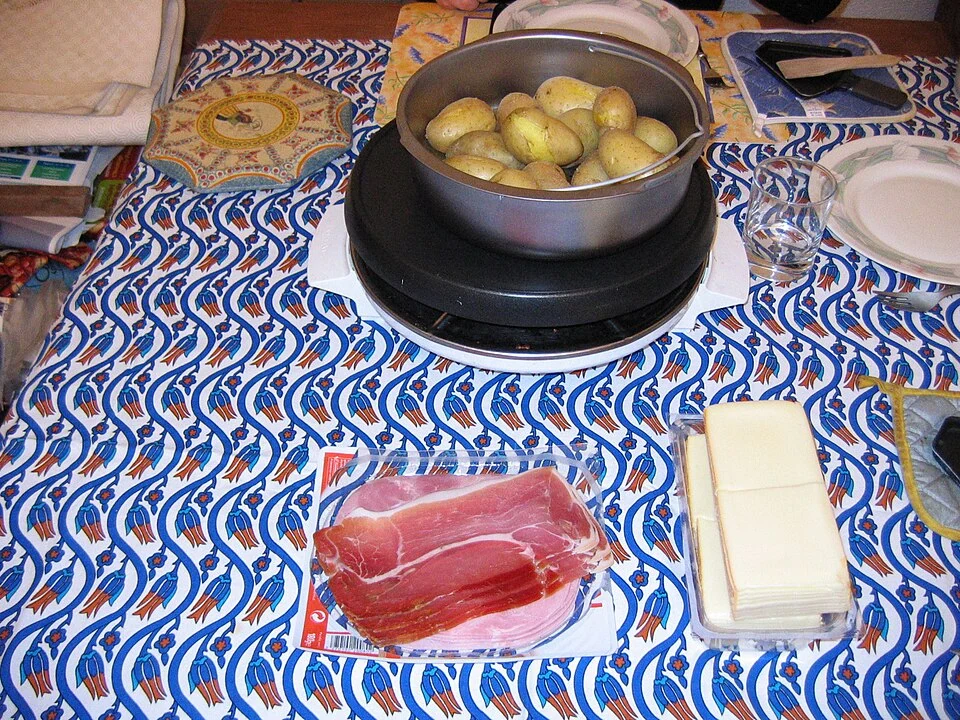
Savoie PGI or Valais PDO, what to choose?
The two cheeses have their place on a raclette table. Choose Savoie if you want to discover a cheese from the French Alps and Valais if you want to find the Swiss tradition of raclée cheese. The taste varies with cheese making and ageing. At the cutting radius, ask to taste two pieces if you hesitate between a soft profile and a more assertive profile. [1] [2] [3]
| Criterion | Savoie PGI Raclette | Raclette du Valais PDO |
|---|---|---|
| Origin | Savoie, Haute-Savoie and delimited communes of Ain and Isère. | Canton of Valais, Switzerland, according to the area of the PDO. |
| Milk | Raw or thermalized cow milk, according to the specifications. | Cow’s raw milk. |
| Hot Texture | Soft and spun paste that spreads by heating and releases little oil. | Folding surface that can be scraped on the plate. Also suitable for pans. |
| Manufacturing benchmark | Minimum eight weeks of ageing. The round grinding wheel measures 28 to 34 cm in diameter. | A minimum of three months for the Raclette du Valais PDO. The specifications provide for a minimum of two months for the name “Raclette du Valais à la Coupe”. |
| Timeline for purchase | Look for the full name “Raclette de Savoie” and the PGI logo. | Look for the name “Raclette du Valais PDO” or have the cheesemaker confirm the origin. |
The Rackette de Savoie PGI In store, a label that says only “scratch cheese” indicates the intended use. To buy the PGI or PDO, check the full name and the quality sign. In store, check the name and the quality mark. Savoie cheese guide allows you to compare the Raclette de Savoie with other specialities in the region. [1] [2]
What raclette flavors to try?
A natural cheese makes it possible to taste milk and ageing. Add a smoky, vegetable or spicy flavor to offer a second different skillet. The Savoyard sector presents its Raclette de Savoie PGI as a natural cheese. Smoked or flavoured products are other commercial variants. Check the product name and the list of ingredients on the label. [4]
| Variant | What taste to seek? | What’s the use of it? |
|---|---|---|
| Nature | A milky taste, more or less pronounced according to ageing. | Potatoes, cooked ham or roasted vegetables. |
| Smoke | A woody taste, to be dosed according to the intensity. | Potatoes and golden onions, or slightly smoked ham. |
| Bear garlic | Notes of garlic and herbs. | Frozen mushrooms, grilled zucchini or potatoes. |
| Mustard | A stinging note more or less present. | Cooked ham and small onions with vinegar. |
| Fenugrec | A spicy and slightly vegetal flavor. | Roasted squash, mushrooms and sweet ham. |
| Pepper or chili pepper | A brighter seasoning. | Natural potatoes or grilled vegetables with little seasoning. |
A goat’s milk raclette can also diversify the assortment. It changes the type of milk and the taste profile. Ask for a supple cheese adapted to the cast iron. For a first tasting, propose it in small quantities next to the cow’s cheese. Specify the milk and seasoning on small labels when the slices are similar.
What other cheeses melt well in the pans?
The Morbier PDO is a good choice to vary while keeping a dough that melts. Its dark line is obtained with vegetable charcoal. Serve a few slices with the natural cheese and compare them first on a potato. Abondance PDO brings a fruity note of Haute-Savoie. Ask for a soft piece and cut it thinner if it is firmer than the raclette. [5] [6] [12]
| Cheese | What He Brings | How can I serve him? |
|---|---|---|
| Morbier PDO | A supple cheese and a different profile from the natural raclette. | Try it in thin slices. It can represent about a quarter of the tray. |
| Abondance PDO | A fruity note and a supple cheese depending on the piece. | Serve a few thin slats. Taste it with potatoes or onions. |
| Saint-Nectaire PDO | A supple cheese and aromas that vary with ageing. [13] | Ask the cheesemaker for a soft piece and cut it off finely. |
| Savoie’s Reblochon PDO | A very creamy, hot texture. | Place a small portion alone in the pan. Watch the cast iron. |
| Gold Mount PDO | A very creamy paste that is easily tabled. | Spread small spoonfuls on the potatoes. |
| Soft goat or sheep cheese | Another expression of milk. The melt depends on the dough. | Ask for a room suitable for cooking. Do a test with a small slice. |
The Reblochon de Savoie PDO and the Mont d’Or are suitable for a small portion tasting. For a raclette where the cheese must be poured with a regular gesture, keep the Raclette de Savoie or Valais as a base. A dry log, a very refined tom or a fresh goat will give a different texture of a slice of raclette. [7] [8]
How to compose a balanced assortment?
For a first raclette with several cheeses, choose two or three varieties. Buy natural cheese in larger quantities. Guests can alternate and the most fragrant cheeses remain tasting options.
| Range | Proposed distribution | Example with 1.2 kg for six adults |
|---|---|---|
| Savoie and Valais | Two thirds of Savoie, one third of Valais. | 800 g of Raclette de Savoie PGI and 400 g of Raclette du Valais PDO. |
| Nature, Smoke and Herbs | Two thirds of a kind, a sixth of smoke and a sixth of a wild garlic. | 800 g of nature, 200 g of smoke, 200 g of wild garlic. |
| With Morbier | Three quarters of a wild raclette, a quarter of a Morbier. | 900 g of natural raclette and 300 g of Morbier. |
| Cow and goat | Three quarters of a natural raclette, a quarter of a goat cheese to melt. | 900 g of natural cheese and 300 g of soft goat. |
To compare several cheeses, start with the sweetest on a natural potato. Then try the smoked or spicy cheese with a little marked accompaniment. Serve the variants in separate plates. If you propose Morbier and smoked sausage, first taste the cheese alone. Then you can add the charcuterie and measure what it changes in the bite.
How much cheese do you plan per person?
For a skillet raclette served as a main dish, 200 to 250 g per adult is a point of sale. The Valaisan recipe with pans, called “raclonette”, uses 1 kg of cheese for four people. Hold the bottom of the fork with several accompaniments or a meal that includes an entrance. Plan up to 300 g for a great appetite if the raclette is the only dish. Weigh the whole assortment before distributing it among the different varieties. [11]
| Number of adults | Cheese with 200 g per person | Cheese with 250 g per person |
|---|---|---|
| 2 | 400 g | 500 g |
| 4 | 800 g | 1 kg |
| 6 | 1.2 kg | 1.5 kg |
| 8 | 1.6 kg | 2 kg |
| 10 | 2 kg | 2.5 kg |
| 12 | 2.4 kg | 3 kg |
For a child, adjust the portion to his/her age and appetite. Anses recommends that young children, pregnant women and immunocompromised people avoid raw milk cheeses, with the exception of cooked pressed cheese. If you serve several cheeses, read the milk type on each package. [14]
To buy trays, look at the net weight. A 400 g tray corresponds to two servings of 200 g, regardless of the number of slices. With 800 g of natural cheese and two 200 g trays of variants, you get the 1.2 kg of the table for six adults.
For a Valais raclette with a half-wheel, the interprofession provides 2.4 to 2.5 kg for eight people in its classic recipe. This marker concerns a piece mounted on a dedicated oven and a service by successive raclage. Ask for a part compatible with the support of your device and check its real weight before buying. [3]
Which cutting and which device to choose?
For individual stoves
Ask for regular slices of skillet width. A slice of about 3 to 5 mm is a convenient starting point. A slice that exceeds can be cut in two. A regular thickness facilitates melting, especially when guests alternate cheeses of different textures.
- Heat the appliance according to its instructions and place a flat slice in each skillet.
- Remove the skillet when the dough has melted and start to brown if you like gratin. A prolonged exposure can dry the surface or separate part of the fat.
- Pour on already hot potatoes or vegetables. To compare cheeses, start with a slice alone.
Cut the edge of the crust if you find it hard or too marked. Check the seller’s or packaging information when the cheese has a coating. If you add mushrooms or onions, cook them and drain them before putting them in the skillet to avoid too liquid a background.
For a half-wheel oven
Choose a half-wheel or portion that the manufacturer of the device indicates as compatible. Set the holder so as to heat the cut side. When the surface is melted, scrape it over a plate, then put the part under the resistance for the next portion. Serve immediately to enjoy the texture. This method is particularly suitable for the Raclette du Valais PDO, and the Savoyard track also describes the tradition of scraping a half-wheel. [3] [4]
How to serve the raclette without a device?
Divide the potatoes already cooked and hot into small dishes that pass in the oven. Cover them with slices of raclette and briefly pass them under the grill, monitoring the melt. Make one serving per person if you serve several cheeses. Keep the pickles and salad for the plate. You can also melt a slice on hot slices of potatoes in the skillet, on low heat and covered.
What accompaniments do you need?
The firm potatoes such as Charlotte or Almandine keep their clothes after cooking. Serve them hot and let each cut them in the plate. Pickles and small onions with vinegar bring crisp and acidic notes next to the melted cheese.
- With a natural raclette, serve cooked ham, green salad and potatoes.
- With a smoky raclette, try golden onions and sweet charcuterie to dose the smoked flavors.
- With wild garlic or Morbier, offer well-drained roasted mushrooms and vegetables.
- For a meatless meal, serve potatoes, roasted cauliflower, peppers or grilled zucchini. For a vegetarian menu, also ask the seller which coagulant has been used.
To vary the salisons, consult the cheese and charcuterie agreements A dry white Savoie, like an Apremont, or a Fendant with Valais cheese are two tracks. A dry Jura Chardonnay can also accompany the Morbier. What wine for a raclette? Details the chords according to the cheese and topping. Sparkling water or acidic apple juice can also accompany the meal. [3]
How to buy the cheese and manage the remains?
At the cutting radius, indicate the number of adults, the type of apparatus and the desired flavors. Ask for thin slices for firmer cheeses, and a cut to the width of the pans for others. Compare the price per kilo by counting the total weight required. To buy near the place of production, check out the Savoie Cheese Road.
Take out a first plate and reload it over the course of the meal. Keep the reserve in the refrigerator. Follow the storage instructions and the deadlines after opening. The guide Keep the cheese in the refrigerator explains how to store the portions. For the next day, What to do with scrape leftovers? offers a gratin, a pan and croques. [9]
Frequently asked questions about cheeses for a raclette
What’s the best cheese for a classic raclette?
The plain Raclette de Savoie PGI is a simple choice for a skillet machine. The Raclette du Valais PDO is also suitable for pans and is particularly suitable for half-wheel scraping.
What difference between the Savoie PGI Raclette and the Valais PDO Raclette?
The Raclette de Savoie PGI comes from an area of the French Alps and can be with raw or thermalized cow milk. The Raclette du Valais PDO comes from the Swiss Valais and is with raw cow milk. The taste also depends on the piece and its ageing.
How much cheese do you plan for a six-person raclette?
For six adults, count 1.2 to 1.5 kg of cheese if the raclette is the main dish. With three varieties, for example, divide 1.2 kg into 800 g of nature and two portions of 200 g of more fragrant cheese.
What thickness of slice to ask for the stoves?
Ask for regular slices of the skillet width. Approximately 3 to 5 mm are a convenient starting point. Cut firmer cheeses more finely.
Can we do a raclette at the Morbier or the Reblochon?
Yes. The Morbier can represent about a quarter of the assortment. The Reblochon gives a very creamy texture and serves well in small portions. Keep a natural raclette cheese for the majority of the tray if you want a regular melt.
Is a smoked raclette a Savoie PGI Raclette?
The line presents the plain Raclette de Savoie PGI. A smoked or flavoured raclette is a choice for its taste. Always check the exact name of the product and the logo on the packaging.
Should the crust of the raclette cheese be removed?
This depends on the piece and your taste. You can remove too firm a edge before melting the slice. Check the seller’s instructions or packaging in case of coating.
Which cheese to choose for a raclette without cold cuts?
Take a natural raclette or garlic from bears, with mushrooms, potatoes and roasted vegetables. A portion of soft goat cheese allows to vary. For a vegetarian meal, check the type of coagulant.
What to do to make the cheese melt without making too much oil?
Melt one slice at a time and remove it as soon as it reaches the desired texture. Avoid letting it heat after melting. If the filling is wet, drain it or serve it directly in the plate.
Sources
- Official Journal of the European Union, unique document of the Raclette de Savoie PGI.
- Interprofession Raclette du Valais, specification of the PDO.
- Interprofession Raclette du Valais, classic recipe and half-wheel service.
- AFTAlp, characteristics, ageing and origin of the Raclette de Savoie PGI.
- Interprofessional Morbier Trade Union, Terms of Reference and Plant Coal Range.
- AFTAlp, texture and profile of Abondance PDO.
- Interprofessional union of the Reblochon, recognize and choose a Reblochon.
- Mount Gold Interprofessional Union, PDO Rules.
- Ministry of Agriculture, Temperature and Refrigeration Storage.
- Raclette service, Maya2003 photography on Wikimedia Commons, CC BY-SA 3.0, converted to WebP.
- Interprofession Raclette du Valais, the raclonnet with the pans and its quantities.
- Interprofessional union of Morbier, recipe for raclette at the Morbier.
- INAO, characteristics of the Holy Nectar PDO.
- Anses, recommendations on raw milk cheeses.