What is Vacherin des Bauges?
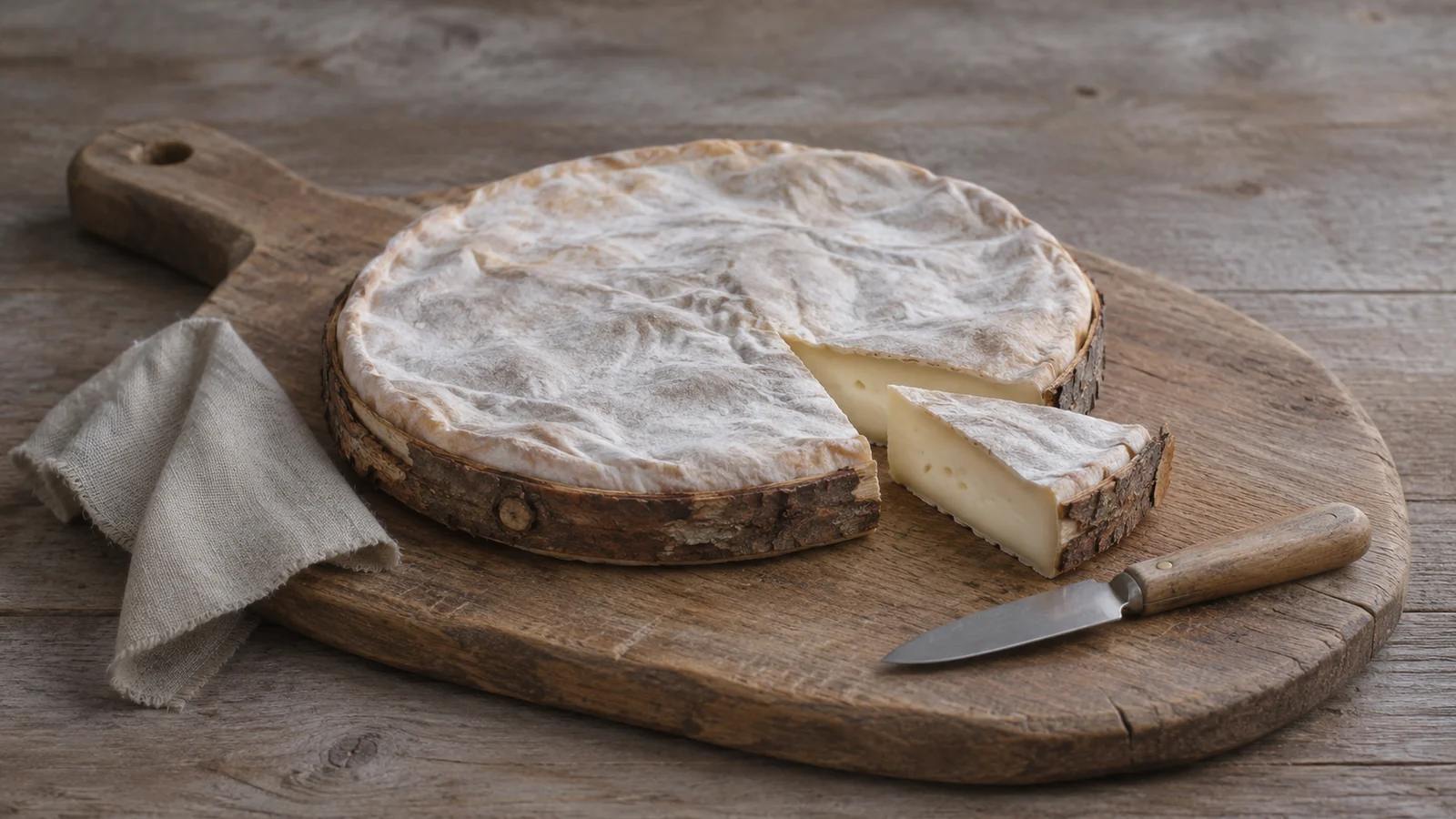
Vacherin des Bauges is a soft, washed-rind cow’s milk cheese from Savoy. Also sold as Vacherin de Savoie, it has a bark band and a creamy centre that can become soft enough to scoop with a spoon. It is a winter speciality of the Bauges massif, particularly the Aillon valley. A slice of bread is all you need to serve it.
How to recognise Vacherin des Bauges
The band holds the sides in place as the cheese softens. Spruce bark is the usual choice, though some accounts of cheesemaking also mention maple. The band gives the cheese woody notes that sit alongside the milky flavour of the paste.
| Feature | How to recognise the cheese |
|---|---|
| Milk | Cow’s milk. Check the label to see how the milk was treated. |
| Paste and rind | Soft, creamy to runny when ripe. The washed rind ranges from white to grey. |
| Shape | Low and round, with a band all the way around. |
| Documented dimensions | Around 20 to 21 cm across for the format recorded in a field study. Size varies by producer. |
| Documented ripening | About 15 days for the process described in the study. The producer can tell you how long a batch has matured. |
| Flavour | Mild and milky, lightly salted, with woody notes that vary by batch. |
| Season | Mainly winter. Availability depends on production. |
The history of Vacherin de Savoie, from Les Mémises to the Bauges
1314: vacherins in the prior of Meillerie’s mountain chalet
In the early 14th century, the priory of Meillerie owned pastures above Lake Geneva. In 1314, a dispute over grazing and other rights set the priory and the town of Évian against each other. People from Évian went up to Les Mémises and forced their way into the prior’s chalet. In his 1961 account, Lucien Quaglia names vacherins and séracs among the provisions eaten or carried away. This record concerns the summer pastures of the Chablais in Haute-Savoie. It leaves the cheeses’ banding, ripening and relationship to today’s Bauges recipe unknown.
In the 18th century, herders pooled their milk on the summer pastures
Around 1715, the prior of Meillerie described how the chalet at Les Mémises operated. People from Thollon and Lugrin took their animals there in summer. Milk was measured at the start of the stay so that cheeses could be divided according to each participant’s contribution. The priory supplied the chalet, the vats and the head cheesemaker. The archives used in the Évian area heritage survey describe an economy in which vacherins were made alongside séracs and butter. Some of the cheese also paid for the use of the pastures.
In the Aillons, a farmhouse cheese for winter
In the Aillon valley, the Bauges regional park’s ethnographic report describes a winter cheese made from cow’s milk. The milk was worked after milking, the rind was washed and a wooden band held the soft cheese in place. The format recorded in the survey measured about 20 to 21 cm across and ripened in about two weeks. That short turnaround helps explain its place on the winter table alongside cheeses matured for much longer.
A farmer interviewed in the Aillons also recalled Colombier, an old cheese made with mixed milks that he compared to vacherin. His account shows the variety of local cheeses and records the name Vacherin des Aillons. Today, some cheesemongers also sell Savoyard vacherins from around Abondance. The producer’s name and village tell you where each cheese was made.
Interviews in the massif record memories of vacherins made at Christmas. The process demanded care. The curd was barely cut, and the mould had to be tightened as the whey drained to keep the cheese in shape. The survey records periods when local production stopped and was later picked up again.
2005: the Gruffy dairy cooperative revives production
In her 2007 dissertation, agronomist C. Heinisch recorded five farmers still making vacherin to order in winter. The dairy cooperative at Gruffy had resumed production in 2005, devoting one vat each winter day to the cheese. That figure describes the revival at the time of the study. The Fruitière du Semnoz still lists vacherin among the cheeses it makes, and Ferme de la Correrie in Aillon-le-Jeune offers it in season.
For more background on these practices, see the history of Savoy cheeses.
Vacherin, Tome des Bauges and Mont d’Or
Tome des Bauges PDO comes from the same area. Its pressed paste and grey, mould-ripened rind are apparent when it is cut. Vacherin is much softer and keeps its band on for serving. Mont d’Or from the Jura and Swiss Vacherin Mont-d’Or can also come with bark bands and be served with a spoon. In the shop, look for the full name and origin on the label.
The Savoy cheeses guide covers the eight cheeses with PDO or PGI status and other regional specialities.
How to serve Vacherin des Bauges
Spoon it onto bread
Open the top of the cheese and spoon out the creamy centre. Serve it with crusty country bread. Thin slices of apple bring a fresh crunch to a cheeseboard. Keep the band around the cheese while serving and remove it before eating.
Serve it warm with potatoes
For a winter meal, spoon the warmed cheese over skin-on potatoes. The baked Vacherin de Savoie recipe explains which dish to use, how to tell when the cheese is ready and how to serve it. Garlic and a splash of dry white wine can flavour the cheese. Add just a little if the vacherin already has a strong flavour.
Which wines go with it?
A dry Savoy white lets the cheese’s milky notes come through. With warm vacherin, Chignin-Bergeron makes for a fuller pairing. If you prefer a red for the cheeseboard, a fruity Gamay with light tannins goes well with the mild cheese.
Where and when to buy Vacherin des Bauges
Ferme de la Correrie in Aillon-le-Jeune lists vacherins in winter. Cheesemongers who buy from the massif may also offer them, depending on deliveries. To plan a visit, see the Savoy Cheese Route and check availability with the farm or shop.
- Check the producer’s name and the village where the cheese was made.
- Tell the cheesemonger how you plan to serve it, either with a spoon on the day or warmed for a meal.
- Follow the temperature, date and storage instructions on the label.
Frequently asked questions about Vacherin des Bauges
Do Vacherin des Bauges and Vacherin de Savoie mean the same cheese?
Vacherin de Savoie is another name used for Vacherin des Bauges. Vacherin des Aillons refers to the tradition in the Aillon valley. Check the producer’s name and the place of production to find out where your cheese was made.
What is the difference between Vacherin des Bauges and Tome des Bauges?
Vacherin des Bauges has a wooden band and is often spooned out. Tome des Bauges PDO is a pressed cheese with a grey, mould-ripened rind. It can be cut into wedges and used to make matouille.
Is Vacherin des Bauges a PDO or PGI cheese from Savoy?
Vacherin des Bauges is outside the list of eight PDO or PGI cheeses represented by the Association des Fromages Traditionnels des Alpes savoyardes. Tome des Bauges, from the same massif, has its own PDO.
When and where can you buy Vacherin des Bauges?
Look for it mainly in winter, direct from a producer in the Aillon valley or from a cheesemonger who buys from Savoy producers. Check whether a batch is available before travelling.
How do you serve Vacherin des Bauges?
Spoon the cheese onto country bread. For a hot dish, warm it in an ovenproof dish and serve it with potatoes. Check the producer’s instructions for the band.
Which wine goes with Vacherin des Bauges?
A dry Savoy white is a simple pairing for the creamy centre. Chignin-Bergeron goes well with warm vacherin and potatoes. For a red, choose a supple Gamay with light tannins.
Sources
- Lucien Quaglia, Annales valaisannes, 1961 — Meillerie and the Grand-Saint-Bernard provostship
- Sidonie Bochaton — Heritage survey of the Évian area, pp. 67–68
- Bauges Massif Regional Nature Park — Food knowledge and practices, chapter on cheesemaking heritage
- C. Heinisch, AgroParisTech, 2007 — Survey of the Bauges cheese sector and the revival in Gruffy
- Fruitières Chabert — Fruitière du Semnoz in Gruffy
- Laiterie des Marches — Vacherin de Savoie
- Bauges Massif Regional Nature Park — Ferme de la Correrie
- Lake Annecy Tourist Office — Savoy cheeses
- Fromagerie Les Alpages — Vacherin des Bauges
- Association des Fromages Traditionnels des Alpes savoyardes — The eight PDO or PGI cheeses
- EUR-Lex — Description of Tome des Bauges PDO