
Which Reblochon should you choose for Savoy tartiflette?
For tartiflette, choose a supple, well-matured Reblochon de Savoie PDO. Farmhouse Reblochon with a green label, made on the farm from the raw milk of a single herd, is a good choice for a stronger flavour. Dairy Reblochon with a red label is also made from raw milk and melts very well. For four people, allow one whole 450 to 550 g Reblochon per 1 kg of potatoes. Keep the rind and face it upwards on the pieces you put on top of the dish. [1] [2] [3] [4]
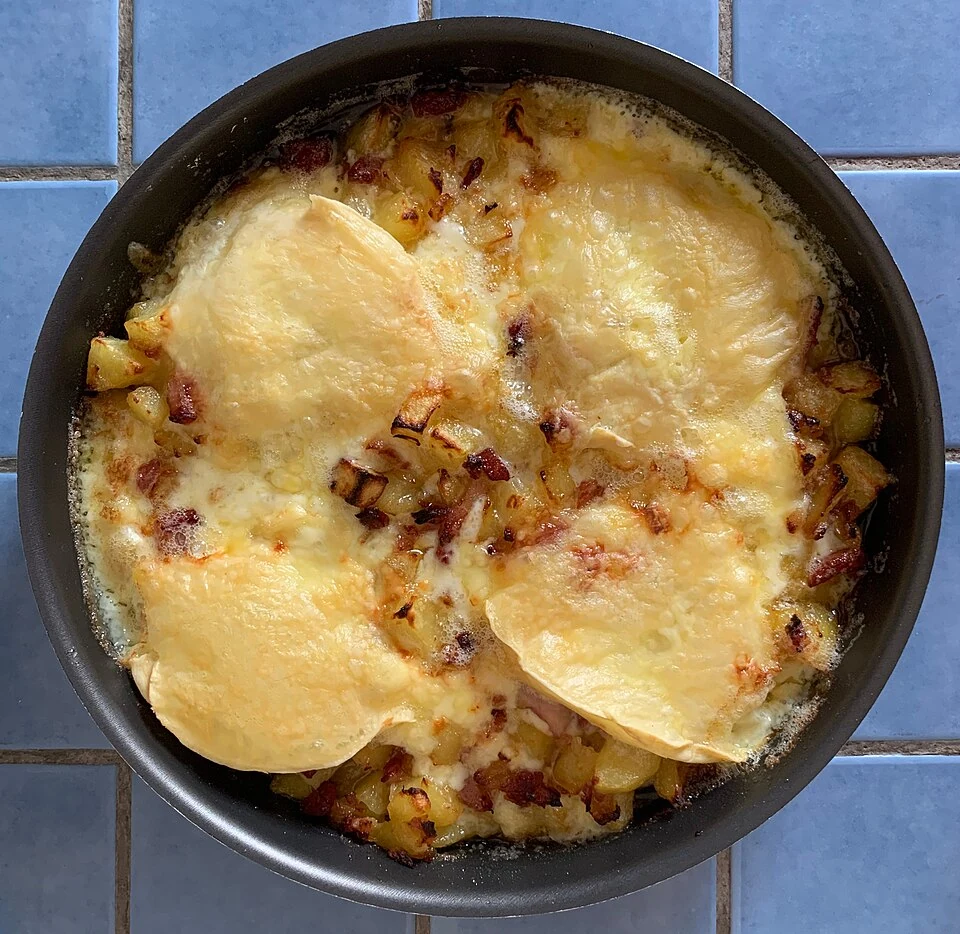
Farmhouse or dairy Reblochon: which should you choose?
Reblochon de Savoie PDO is an uncooked pressed cheese with a washed rind, made from whole raw cow’s milk. Both versions follow the same specification. The casein label identifies how it was made and allows you to trace the workshop and batch. It gives no indication of the cheese’s age or strength. [1] [2] [3]
| Feature | Farmhouse Reblochon PDO | Dairy Reblochon PDO |
|---|---|---|
| What to look for | Green label and the word “fermier” on the packaging. | Red label. Check the name and PDO logo on the packaging as well. |
| Milk source | Whole raw cow’s milk from a single herd. | Whole raw milk collected from several farms. |
| Where it is made | On the farm, following milking. | At a dairy or cooperative, sometimes called a fruitière. |
| Flavour in the dish | Choose it if you want a stronger flavour. Taste the cheese if you can. | Choose it for a milder result if the piece suits that profile. A well-matured dairy Reblochon can have plenty of character too. |
| When to choose it | For a tartiflette where you want the cheese to stand out, especially with lightly smoked lardons. | For diners with different tastes, or if a supple piece better suits your budget. |
Farmhouse Reblochon is the first choice for a full-flavoured tartiflette. If some guests prefer a mild taste, ask for a supple dairy Reblochon. If the cheesemonger offers a farmhouse cheese that is still firm and a dairy cheese that is ready to eat, choose the latter for dinner that evening. How mature the piece is matters more for texture than the colour of the label. [1] [2] [3]
Both versions use raw milk. Reblochon’s characteristic hazelnut notes develop during maturation. In the oven, the cheese melts between the potatoes and the exposed rind browns. The final flavour also depends on the amount of cheese, how smoky the lardons are and how you assemble the dish. [1] [4]
How to recognise a good Reblochon when buying
Read the full name and look at the cheese
Look for Reblochon or Reblochon de Savoie with the PDO logo. The words fromage à tartiflette on their own describe a use in cooking. They do not guarantee Savoy origin or compliance with the specification. If the label is unclear, check the exact name or ask the cheesemonger to confirm that it is Reblochon PDO. [1] [2]
- Look at the rind. It is thin, yellow to orange, and sometimes covered with a light white bloom. The producers describe this as a characteristic of the cheese. [1] [2]
- Look for a supple texture. If you are cooking that day, ask for a piece with a soft, creamy paste. A very firm cheese will be harder to spread through the dish. [2]
- Look at the cut surface if buying a half. It tells you how firm the paste is. The label may be on the other half. Ask the seller to confirm the version if it matters to you. [2] [3]
- Compare the price per kilogram. A Petit Reblochon or a half-wheel may leave less surplus for two people. For four, compare the price of a whole wheel with that of two smaller cheeses. [2]
Choose a piece that will be ready on the day
The Reblochon producers’ association indicates at least 18 days of maturation. That minimum tells you about the designation. For cooking, ask whether the piece will be ready to use on the date you need it. If you buy the cheese in advance, keep it according to the packaging and tell the cheesemonger when you will cook it. [1] [2]
A supple piece cuts cleanly straight from the refrigerator. If it sticks to the blade, wipe the knife between cuts. Keep the most even pieces for the top and spread the trimmings among the potatoes. This puts cheese into servings cut from the centre of the dish too. [4]
Where can you buy Reblochon?
At a cheese counter, the seller can show you the paste and compare cheeses of two different ages. At the supermarket, look for the exact name, the PDO logo and the net weight. If buying in Savoie or Haute-Savoie, the Savoy Cheese Route shows farms, village dairies and cellars to visit. The Savoy cheeses guide places Reblochon among the region’s other PDO and PGI cheeses.
How much Reblochon do you need?
A standard Reblochon weighs 450 to 550 g. A small one weighs 240 to 280 g. The producers’ recipe uses one whole cheese for 1 kg of potatoes and four diners. The table scales that ratio. Weigh the potatoes before preparing them. [2] [4]
| Number of diners | Potatoes | Reblochon PDO | Suggested dish and assembly |
|---|---|---|---|
| 2 people | 500 g | About 225 to 275 g. Half a standard Reblochon or one small whole cheese works. | A small dish or two ramekins. |
| 4 people | 1 kg | 450 to 550 g, or one whole standard cheese. | A medium dish, with some cheese mixed into the filling and the rest on top. |
| 6 people | 1.5 kg | About 675 to 825 g, or one and a half standard cheeses. | One large shallow dish or two smaller ones. |
| 8 people | 2 kg | 900 g to 1.1 kg, or two standard cheeses. | Two dishes to give the topping enough room to brown. |
Start with about 500 g of cheese per kilogram of potatoes. For a side dish, serve smaller portions but keep the ratio. If you have only half a Reblochon for four people, use a smaller dish and a shallower layer of filling to spread the cheese evenly. A large dish with a few pieces spaced far apart will leave more mouthfuls without cheese.
How to cut the Reblochon and bake the tartiflette
The basic recipe for four people
- 1 standard Reblochon de Savoie PDO.
- 1 kg of firm-fleshed potatoes. They hold their shape when mixed.
- 200 g of lardons and 2 onions for the filling.
- 10 cl of dry white wine if using wine, and pepper. Taste the potatoes with the lardons before adding salt. [4]
- Cut the potatoes into even pieces and parboil them until a knife tip goes in with a little resistance. Brown the onions and lardons in a frying pan. If using wine, pour it into the pan and let it reduce before filling the baking dish.
- Lay the Reblochon flat and slice it horizontally through the middle to make two discs. Dice one disc and mix the cubes with the potatoes. Cut the other into two or four pieces, depending on the shape of the dish.
- Lay these pieces on the filling rind side up, cut side against the potatoes. Bake in an oven preheated to 200°C. Allow 15 to 20 minutes if the filling is already hot and the potatoes have been parboiled. Take it out when the top is golden and the centre is hot. [4]
Should you keep the rind, add cream or use wine?
Keep the rind. The producers’ recipe leaves the rind on the top disc so that it browns. The paste facing the filling melts among the potatoes. Cutting up the top disc lets you share the browned topping among all the plates. [4]
Cream is optional. The producers’ recipe relies on Reblochon and the juices from cooking the onions and lardons. If adding cream, start with a small amount so the dish holds together. You can also deglaze with a splash of water if you are cooking without wine. For a bottle to serve or cook with, see Which wine goes with tartiflette?. [4]
How to fix a gratin that is too dry or too runny
| Result | Common cause | What to try |
|---|---|---|
| Potatoes still firm | Pieces that are too thick or parboiled for too short a time. | Parboil them longer and cut them into evenly sized pieces. |
| Gratin too runny | Filling not drained properly or wine added without reducing it. | Drain the potatoes and reduce the liquid in the pan before assembling the dish. |
| Cheese melted only around the edges | The cheese was concentrated in a few large pieces. | Spread cubes through the filling and cut the top disc into several pieces. |
| Brown top but cold centre | The dish was very deep or the ingredients were cold when assembled. | Use a shallower dish. If the top is already browning, cover it temporarily and continue baking until the centre is hot. |
Which cheeses work in a gratin inspired by tartiflette?
Reblochon is the cheese for Savoy tartiflette. If you cannot find it, the same potatoes, onions and lardons can form the base of a different gratin. Choose a cheese for the flavour and texture you want. A supple cheese spreads more easily in small pieces, particularly if you combine several cheeses. [4] [5]
| Cheese | What to expect | How to use it |
|---|---|---|
| Raclette de Savoie PGI | A soft, melting topping with the flavour of raclette. | Cover the potatoes with slices and tuck a few strips into the filling. |
| Saint-Nectaire | A flavour that can recall a cellar and a supple paste, depending on maturation. | Spread thin slices over the dish and taste the cheese before choosing the other ingredients. |
| Brie or Coulommiers | Creamy paste and a bloomy rind. | Space the pieces across the surface and use a thin layer. |
| Camembert or Munster | A stronger aroma, especially if the cheese is well matured. | Start with a few evenly spaced pieces and choose lightly smoked lardons. |
| Mont d’Or PDO (Vacherin du Haut-Doubs) | A creamy paste that coats the potatoes. [8] | Spoon some of the cheese over the dish and reduce the liquid in the filling. |
| Goat cheese | Goat’s milk flavour and a texture that varies by cheese. | Add small amounts here and there. Fresh goat cheese gives creamy spots rather than an even layer. |
For a Savoy variation, Raclette de Savoie PGI is the easiest to spread across the dish. If you have several little pieces to use up, choose a supple cheese as the base and add a little of a stronger cheese. The dish will be easier to serve and the flavours easier to distinguish. [5]
How to store and use leftover cheese
Keep unused Reblochon in the refrigerator, in its packaging or wrapped separately. Follow the temperature and storage instructions after opening. If you have raclette cheese and cooked potatoes, What to do with leftover raclette suggests a gratin with onions and ideas that do not require an oven. For other pieces of cheese, see How to store cheese in the refrigerator. [6]
For cooked tartiflette, divide the leftovers into small portions and refrigerate them within two hours. The Ministry of Agriculture recommends eating home-cooked leftovers within 48 hours. Reheat only what you need and check that the centre is hot. [6]
Frequently asked questions about Reblochon for tartiflette
Which Reblochon should you use for Savoy tartiflette?
Choose a supple, well-matured Reblochon de Savoie PDO. Pick a green label for a farmhouse cheese with more character. Dairy Reblochon with a red label works very well too.
Is dairy Reblochon pasteurised?
Both versions of Reblochon de Savoie PDO are made from whole raw cow’s milk. Dairy Reblochon is made at a dairy or cooperative using milk collected from several farms.
How much Reblochon for 1 kg of potatoes?
Allow one whole 450 to 550 g Reblochon per 1 kg of potatoes. This gives about four main-course portions.
Can you make tartiflette for two with a Petit Reblochon?
Yes. A Petit Reblochon of 240 to 280 g or half a standard wheel suits about 500 g of potatoes. Choose a dish small enough for the cheese to cover the top.
Should you remove the Reblochon rind?
Keep the rind and face it upwards on the top pieces. Lay the cut side on the potatoes so the paste melts into the filling.
Can you make tartiflette without cream?
Yes. The producers’ recipe uses no cream. Melted cheese, onions and the cooking juices are enough to bind the filling.
What does “fromage à tartiflette” mean on a label?
It tells you what the cheese is intended for. To buy the cheese used in the Savoy recipe, look for the name Reblochon or Reblochon de Savoie and the PDO logo.
What can you use instead of Reblochon in a gratin?
Raclette de Savoie gives a melting topping. Brie and Coulommiers give a creamier texture, while Munster has a stronger flavour. These cheeses work in a gratin inspired by tartiflette.
Sources
- Reblochon producers’ association, specification and cheesemaking stages.
- Reblochon producers’ association, recognising and choosing Reblochon PDO.
- Reblochon producers’ association, differences between farmhouse and dairy production.
- Reblochon producers’ association, tartiflette recipe for four people.
- AFTAlp, characteristics of Raclette de Savoie PGI.
- Ministry of Agriculture, preparing and storing home-cooked leftovers.
- Tartiflette straight from the oven, photograph by Benoît Prieur on Wikimedia Commons, CC0 1.0, converted to WebP.
- Mont d’Or producers’ association, characteristics of the PDO.