All about Emmental de Savoie
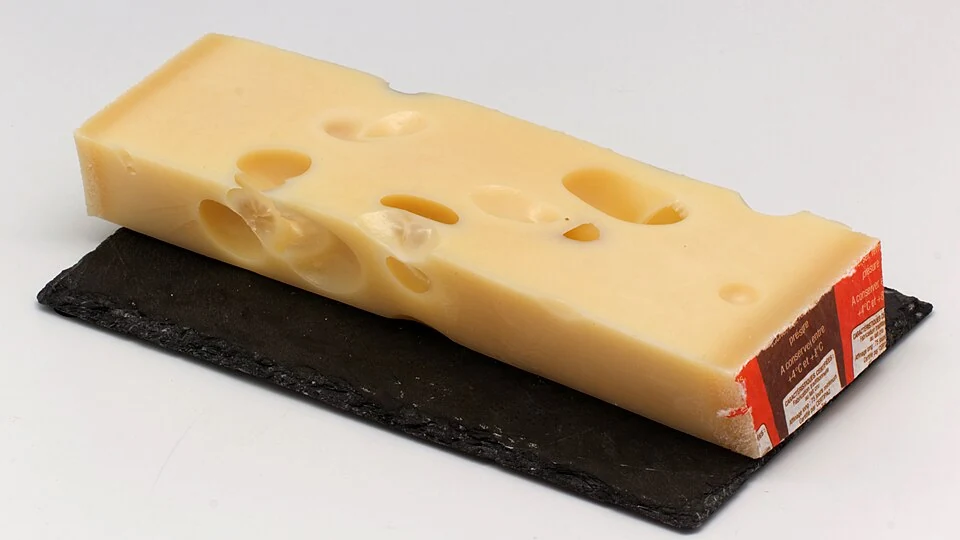
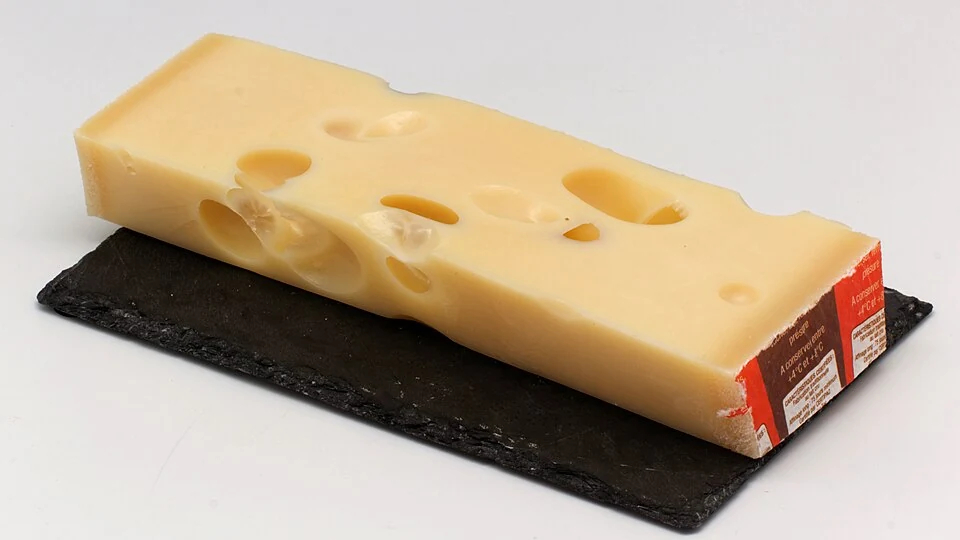
Emmental de Savoie PGI is a cooked, pressed cheese made from raw cow’s milk and matured for at least 75 days. It has a firm yet supple texture, a fruity flavour and large openings known as “eyes”. On a whole wheel, look for the red “Savoie” stamp on the heel, the outer edge of the wheel. If you are buying a cut or prepacked portion, check for the full name “Emmental de Savoie” and the PGI mark. [1] [2]
How to recognise Emmental de Savoie PGI
The producers’ association uses three figures to describe the cheese. A wheel weighs about 75 kg, measures about 75 cm across and matures for at least 75 days. The weight and diameter are typical figures. The official specification sets a minimum weight of 60 kg after maturation and a diameter of 72 to 80 cm. [1] [2]
| Feature | What to look for |
|---|---|
| Milk and curd | Raw cow’s milk. The curd is heated and then pressed. [1] [3] |
| Wheel | Round and domed, 72 to 80 cm across and 14 to 32 cm high. [1] |
| Weight | About 75 kg according to the producers’ association. At least 60 kg after maturation. [1] [2] |
| Rind and stamp | Yellow to yellow-brown rind, with a red “Savoie” stamp on the heel. [1] [2] |
| Paste and eyes | The paste is yellow, firm and supple. The eyes are evenly distributed and range from the size of a small cherry to that of a walnut. [1] [3] |
| Flavour | A distinct, fruity flavour. [1] |
| Maturation | At least 75 days. [2] |
| Fat content | At least 28% in the finished cheese. [1] |
The figure of 45% fat in dry matter appears in a 2003 certification notice. It expresses the fat content as a proportion of what remains after the water is removed. The 28% minimum in the European document applies to the finished cheese, including its water content. [1] [7]
At the cheese counter or in the supermarket, these tips can help you choose.
- At the counter, ask for the full name. A cut piece can carry the PGI even if the red stamp is no longer visible on that portion.
- In the aisle, look for “Emmental de Savoie” and the European PGI logo. Cheese sold under this name also comes sliced, diced or grated. [1]
- To eat it on its own, look at the cut surface. Large, evenly spaced eyes and a supple texture tell you what type of cheese to expect. The label confirms its origin.
- To compare prices, check the price per kilogram on portions sold in the same format. A wedge with the rind on and a bag of grated cheese suit different uses.
- For several meals, buy a whole piece, cover the cut face and grate only what you need. The guide to storing cheese in the refrigerator explains how to wrap and store it.
History of Emmental de Savoie
From long-keeping cheeses to Swiss influence
Since the Middle Ages, Alpine cheesemakers have turned the abundant milk of the warmer months into large wheels of cooked cheese that keep until winter. Emmental de Savoie grew out of that tradition. The name “Emmental” comes from the Emme Valley in Switzerland. Exchanges with Switzerland went on to shape the practices of Savoyard cheesemakers. [4] [6]
Pooling milk in village dairies in the 19th century
Grand Annecy’s agricultural assessment records an early Haute-Savoie dairy, or fruitière, at Viry in 1822. Farmers pooled milk from several farms and entrusted cheesemaking to a specialist known as a fruitier. Pooling the milk made it possible to produce large wheels and gave the village a shared workshop. According to the producers’ association, Haute-Savoie had 417 fruitières in 1900. [4] [5]
Mild or heated cellars also changed the cheese. Cheesemakers found that time in these cellars encouraged the formation of eyes and changed the texture and flavour. Developing the openings became a distinct step in maturation. [3] [4]
From industrial production to protecting its origin
In the 20th century, large-scale Emmental production expanded outside Savoie and Haute-Savoie. Producers in the two departments then defined where the milk could come from and how the cheese should be made in a regional specification. The interprofessional association was formed in 1990. Emmental de Savoie received European PGI recognition in 1996. The history of Savoy cheeses explains how this change fits into the region’s wider story. [4] [5] [6]
Production still centres on village dairies
The PGI area covers Savoie, Haute-Savoie and certain neighbouring municipalities in Ain and Isère. Milk production and collection, cheesemaking and maturation all take place in this area. Across the herds supplying milk to the processor, at least 75% of the cows must be of the Abondance, Montbéliarde or Tarentaise breeds. Tarentaise is also known as Tarine. The producers’ association reported three cheesemaking fruitières in 2024. [1] [4]
How do the eyes form during maturation?
Once the milk coagulates, the cheesemaker cuts the curd into grains, heats it, places it in moulds and presses it. The wheel is then salted in brine and matured in several cellars. Cheesemaking starts with raw milk. The curd is heated after coagulation, which is why the cheese is described as cooked and pressed. [3]
In the warm cellar, fermentation produces carbon dioxide. Trapped inside the cheese, the gas gradually forms the round openings known as eyes. Cutting into the wheel reveals their size and distribution. The stamp and label are the ways to check that the cheese carries the PGI. [1] [2] [3]
Which cut should you choose for a gratin, fondue or cheese board?
| Use | Which cut to choose | How to use it |
|---|---|---|
| Gratin | A whole piece | Grate it just before topping the dish so you can spread it evenly. |
| Fondue | A piece to grate or cut into small cubes | Combine it with Beaufort PDO or Abondance PDO. |
| Cheese board | A portion that clearly shows both the rind and the paste | Cut it into thin slices to see the eyes and appreciate the supple texture. |
| Sandwich or toasted sandwich | Thin slices | Arrange the slices on the bread so they cover the filling. |
When putting together a blend, the guide to which cheeses to use for fondue compares the Savoy cheeses that melt well. The Savoy Cheese Route includes an Emmental stop in Vallières-sur-Fier. The Savoy cheeses guide lets you compare it with the region’s other PDO and PGI cheeses.
Frequently asked questions about Emmental de Savoie PGI
Is Emmental de Savoie PGI made with raw milk?
Yes. The cow’s milk is raw when cheesemaking begins. “Cooked and pressed” describes what happens to the curd after the milk has coagulated.
Why does Emmental de Savoie have holes?
During maturation, mainly in the warm cellar, fermentation produces carbon dioxide. The gas is trapped in the cheese and forms openings known as eyes.
How much does a wheel of Emmental de Savoie weigh?
A wheel weighs about 75 kg according to the producers’ association. The minimum weight after maturation is 60 kg. The official diameter range is 72 to 80 cm.
How long is Emmental de Savoie matured?
It matures for at least 75 days. The cheese moves through several cellars, including a warm cellar where the eyes develop.
Can you use Emmental de Savoie in fondue?
Yes. It goes well with Beaufort or Abondance. To help the blend melt evenly, grate the cheeses or cut them into small pieces of similar size.
Sources
- Official Journal of the European Union, Emmental de Savoie PGI single document, 2020
- AFTAlp, Emmental de Savoie PGI profile and typical wheel dimensions
- Savoîcime, how Emmental de Savoie is made and matured
- Savoîcime, the history of Emmental de Savoie
- Grand Annecy, agricultural assessment of the Annecy area, p. 50 onward
- INAO, Emmental de Savoie profile and PGI recognition
- DGCCRF, Emmental de Savoie certification notice, 2003